The loneliness of running

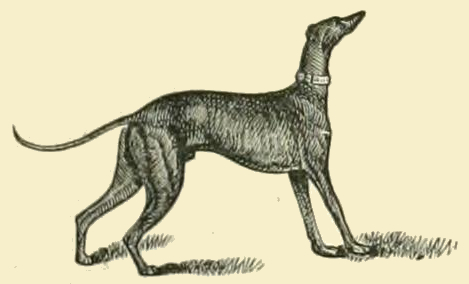
Greyhound_Drawing

Long distance running once had more purpose — say, chasing an enemy across the savannah to jam a spear into his throat, or being chased to have that thing with a spear done to you.

Then again, you might be running after food, and that’s definitely more useful. Animals run faster than we do but can’t run as far, so you will eventually catch one if you keep it up. Messengers also ran long distances in the old days, but that was their job. We know of at least one who, after gasping out news of a victory over the Persians, died on the spot. Or so the legend goes.

At the ancient Olympics, foot races were strictly sprints, so forget about the Greeks: no staying power. Some native peoples in the Americas, however, did run long distance races, and I suppose that was for glory.

I’m still trying to puzzle out why I run. The ancient inducements — vengeance, hunger, news, glory — no longer apply. My moods are under control, my fridge is full and I have a phone. As for the much-discussed runner’s high, I’m still waiting….

The compulsion is a mystery.

Cross-country gulping

I had a high school gym teacher who was a devotee of cross-country running. Close-cropped silvery hair, lean physique, pointy nose: he actually looked like a greyhound. A Brit, of course, as the Brits pretty much invented and excelled at cross-country running for generations.

Since our school was at the foot of Mount Royal, there was simply no escaping his mania. At least once a week, we’d be forced to jog along Park Avenue and take the urine-drenched tunnel at Duluth, emerging from the other side dopey with low-level ammonia poisoning. We began our ascent beside the bronze lions of the George-Étienne Cartier Monument, taking the sloping path to the right, then up the 400-odd steps, past the cross and on to Beaver Lake.

Here we’d pause, gulping air and hating our lives. By this point our lungs were on fire and the bones in our trembling legs had dissolved.

Shamelessly, I tried to weasel out of it by claiming bronchitis. Others produced dubious doctor’s notes. They feigned injury, wept openly. The greyhound wasn’t buying it.

“Up we go, lads!”

Of course, a few of my classmates were naturals, with lean muscles, massive hearts and lungs, and arteries like garden hoses. They held a steady pace all the way, effortlessly loping along and out of sight within minutes of our start.

Paul was one of these gifted boys. He had a Montreal Gazette route and persuaded the paper to sponsor him on a bike ride to Vancouver, literally cross-country — more than 5,000 km. This was long before such feats were common, so he did the distance, quietly and alone, and took the train back, paid for by the Gazette. Not a penny was raised for cancer, the homeless or universal understanding.

After his summer ride, Paul showed me his mouldering maps and a curled Hillroy exercise book that contained a daily log. He averaged more than a hundred miles each day (160 km), pitching his tent and unrolling his sleeping bag wherever he happened to conk out.

Running: The Movie

A couple of years ago, I saw a black and white movie from the early Sixties titled The Loneliness of the Long Distance Runner. It’s pretty raw, in the realist manner of post-war cinema. Angry young men with impenetrably thick accents thoroughly pissed at the upper classes. While North Americans were riding an economic boom, the English were still clearing rubble and struggling under punishing austerity — as were most Europeans.

The movie is about a kid in the North of England, probably about Paul’s age, who’s caught robbing a bakery and is packed off to reform school (Borstal schools, they called them). He discovers cross-country running, which somehow gives focus to his identity and rebellion. It’s a far cry from Chariots of Fire, offering limited uplift, reconciliation or redemption, and certainly no haunting Vangelis score.

But it’s sometimes grimly funny, as when he boasts, “Running has always been a big thing in my family, especially running away from the police.”

At least this kid got something from long-distance running. For me, it remains utterly pointless. No ball or puck to put into a net. No exhilaration, no sense of satisfaction.

But the utter pointlessness is precisely the point — like writing these dispatches each week. They are useful to no one; they offer no information or even informed opinion. And yet I keep putting one foot in front of the other, one word after another.

The queen of Park Ex

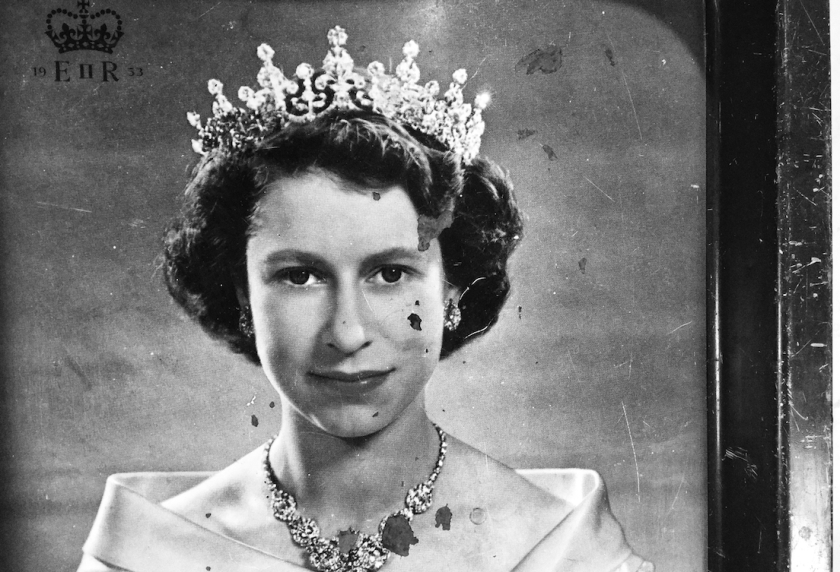
Liz

Shortly after Greece’s independence in 1821, the Great Powers determined that what Greece really needed, after centuries of arbitrary rule under the Ottoman yoke, was a family of Northern Europeans telling Greeks what to do.

If you know anything about Greeks, it’s that they have enough trouble following instructions from each other, let alone from a foreigner in a sash.

And yet, after some false starts a suitable family — the Danish Glücksburgs — was installed and various dynasties proceeded to fall in and out of favour over the next century-and-a-half. One king was assassinated while out for a stroll. Another king, George II, said this: “The most important tool for a king of Greece is a suitcase.”

After decades in exile, ex-King Constantine II recently packed his suitcase and moved back to Greece because it’s cheaper than London. He’s a first cousin of the Duke of Edinburgh and I’m told he makes a mean mousaka.

History’s long tail

I don’t know how the day began in Catholic schools, but in the English Protestant one I attended in Park Ex, we stood beside our desks, faced the flag and sang “God Save the Queen.”

This is impossible to imagine in French Catholic schools. French Quebecers could never quite stomach, nor understand, the Anglo fetish for royals. (To them, naming Montreal’s flagship hotel the Queen Elizabeth was one of countless “provocations.”)

Just about every Canadian town and city has its Queen and King Streets, its Victoria Hotels and Duke of Edinburgh schools. It must seem odd to our American cousins, whose only titled citizens are Duke Ellington and Count Basie.

In school we also sang “Marching to Pretoria,” from the Boer War, where Churchill made his reputation as a war correspondent and thousands of black Africans perished serving one or another of the white teams. Thousands more perished, black and white, in the innovation for which the Boer War is most famous — concentration camps.

Cheer up boys and sing good luck to all our gallant men
Who fought for the Empire out in Africa and when
They have brought the seas once more we welcome home again
Conquerors of proud Pretoria

Empire was everywhere. Aromas of leather and wet wool, mothballs and fried fish. War memorials of identical boys with clipped moustaches. Photos of ladies knitting socks. It was all very far away, but also at the heart of the world around us.

The long tail of history and of Empire is still with us. I had cause to reflect on Empire and past mistakes throughout this week.

Last Friday I posted a short story titled “The Imperial Matinée.” A reader gently reminded me that the Park Ex cinema where some of the story unfolds was actually the Empire Cinema. I fixed my mistake.

But it also reminded me that Montreal once had two cinemas, separated by maybe a dozen stops on the number 80 bus, both paying tribute to the idea of Empire.

The Empire Matinée — a new story

Matinée

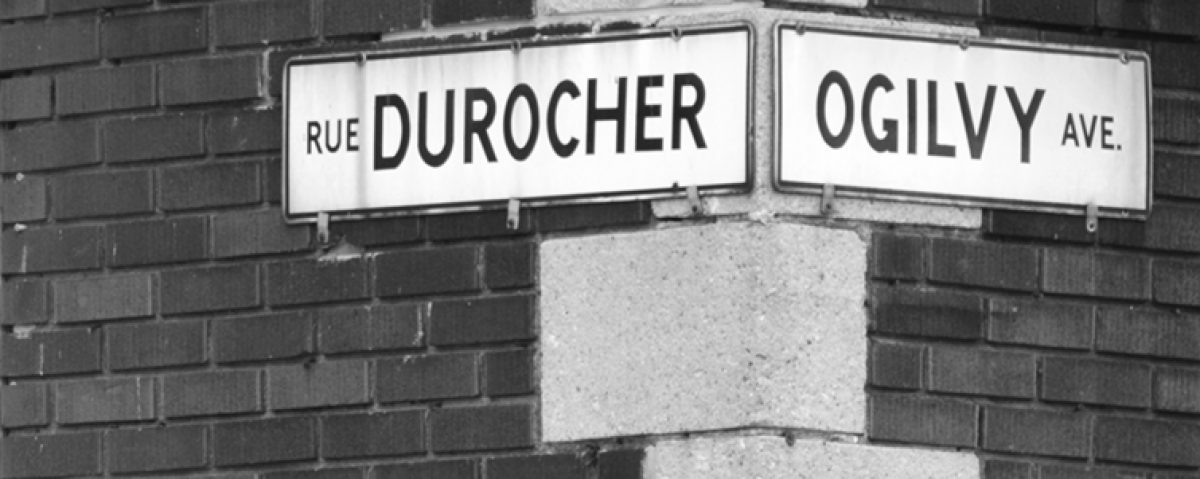
A couple of weeks ago, on Facebook, a woman remarked that she recognized the street signs on my blog’s masthead photo. They’re attached to the building she used to live in many years ago. She also remarked that across the street stood the Imperial Cinema.

As it happens, I was at that time wrestling with a short story that, in part, takes place in the Imperial. So here is that story. It’s called The Empire Matinée, and I hope you like it.


The l’Acadie fence

Fennce

When I lived in Park Ex, we often rode our bikes through a gate on l’Acadie Boulevard and into Town of Mount Royal. The mile-long fence separating Park Ex from TMR was infamous among urban planners and activists across the country — even written about in the U.S.

Once a year or so, an article would unfailingly appear in some local paper about the unembarrassed way the fence divided working-class from middle-class Montreal. It was our Berlin Wall, or directly descended from apartheid barriers. (You always have to leave some room for journalistic hyperbole.)

The fence never became a big enough cause célèbre to convince anyone to bring it down. It’s still there, still doing an excellent job.

Profiling

The l’Acadie fence was not just a physical barrier, of course. It separated worlds.

At first, we crossed into TMR just to ride around and ogle the houses we could only dream about. Houses with lawns and finished basements and garages and, somewhere inside, colour TVs and cool air-conditioned rooms.

As we grew older, the rides into TMR gained purpose. We wanted access to services. So we’d ride to the centre of town and run the quarter-mile track attached to TMR High, or shoot hoops at the courts next to the town hall. (We weren’t the only interlopers. Kids from the Côte-des-Neiges area would also arrive for pickup games, lime-green combs poking from their Afros.)

The police occasionally stopped us en route. I’ve always wondered how they knew we didn’t belong. Did something about our faces and haircuts tip them off? Maybe our cheap clothes and banged up bikes told them we weren’t Townies.

When they stopped us, the cops were unfailingly polite and unthreatening. (We were white kids, after all.) They asked where we lived and where we were going. One time, they pumped us for information. Someone had been stealing bikes. They mentioned a name. Did we know this individual?

To be fair to the cops and to their impulse to profile, I suppose a Park Ex kid was more likely to steal a bike than a TMR kid.

Look at me — the first bike I ever owned was stolen. Thirty-five bucks for a white Mercier with racing handlebars. A guy about my age, who lived around the corner, sold it to me.

So the police were right.

I now live in house with a lawn. We have air-conditioning and an alarm to keep people from stealing our stuff.

Lately, though, there’s been a rash of burglaries in our area. It might only be a matter of time.


Smells like running


Illustrations1

People smarter than I am have remarked on the very short distance between the nose and brain. Scents, especially when they arrive unexpectedly, can conjure up ghosts with devastating clarity. You find yourself on the edge of tears without knowing exactly why.

Incense
I often run by a spot near home where someone burns incense. To my nose, it’s the same incense as they burn in Greek Orthodox churches.

This happens occasionally but not always, making it hard to anticipate or to locate its source. So I’m never prepared for the sudden and overpowering presence of the livani, or for how it catapults me back several decades and halfway across the city to Agia Triada (Holy Trinity), the Greek Orthodox church that stood at the corner of Sherbrooke and Clark Streets.

Inside, an enormous chandelier and a trapped sparrow. Below, this sinner shrinks under the glare of the all-seeing eye of God painted at the centre of the dome.

Agia Triada burned down years ago. But every time I run through the cloud of incense, somewhere near home, she rises up again.

Meat

The Club gathers in a residential development on Monday nights for the weekly tempo run. If you know where to look, you might spot a discreet piece of reflective tape on a parking sign every 500 metres, marking one quarter of the 2k loop.

Round and around we go.

The housing development is new, without a tree in sight. The roads are wide and immaculate. On tiny pieces of land, massive houses squat like giant toads. The developers have installed warlike turrets and crenellations, as if to protect the houses from an invasion of proportion and taste.

Fine. Maybe I’m a little irritable. I haven’t eaten since lunch, so that I can run on an empty stomach.

It’s not helping, either, that the locals choose to grill meat at this hour, venting powerful exhaust fans from their fancy Wolf stoves directly at the road. Already light-headed from fasting and runner’s pain, the aromas waft me to a long-ago village agora.

I am seven years old. A man stands behind a small charcoal brazier. His left arm ends at the elbow, and a disembodied sleeve is neatly folded and pinned to his upper arm. With his remaining hand he tends a dozen bamboo skewers threaded with bits of meat. Lemony oregano fills the air. An adult hands over a coin. The man behind the brazier squeezes a lemon wedge on a souvlaki, places it on a waiting slice of bread and gives it to me.

I am afraid to eat it because then it will be gone.


The 80 goes to Place d’Armes

I often say that going for a run clears the mind. As if my cramped attic room gets cluttered with furniture and inessentials between runs, and an hour on the road helps to blow it all into a pile in the corner.

A “lower-body injury” and the flu have prevented me from running much over the past several weeks, generating more-than-usual clutter. But I did manage a therapeutic run the other day, under a brilliant sun and over fresh snow.

All better now. And the run helped me focus on the 1969 NFB documentary, The 80 Goes to Sparta, which I saw some years ago and that friends have been telling me to revisit. (The other one to revisit is last year’s Return to Park Ex, by Tony Asimakopoulos. Perhaps in another post…)

The 80 is my agora

For me, the 80 was always something of a village on wheels. When I lived in Park Ex, I would often hop on the southbound 80 on Saturday mornings, a fat weekend Gazette under my arm, and grab the last two-seater on the right-hand side. This gave me a chance to catch up on the news, eavesdrop on people getting on and off, and enjoy the familiar sights of Jean Talon, Park Avenue, Mount Royal and Bleury. There was nothing more comforting.

By the time we got to the end of the line, at Place d’Armes, the 80 was nearly empty. I’d exit through the rear door and immediately line up to get back on. My seat was still warm when I sat down again and unfolded the paper. The driver would then head north, to the other end of the line, at Crémazie Boulevard. A third ticket (student tickets were cheaper then) got me home, by which time I’d pretty much read the entire paper.

I knew this was an odd thing to do. Now that I’m older I realize it was a very odd thing to do.

The rich don’t ride the 80

A friend came for breakfast last Sunday, and we talked about the documentary and the memories it evokes. For her, it’s personal: she recognized her mother, family members and friends, and had a chance to revisit the now vanished world she grew up in.

The 80 Goes to Sparta opens with a close-up of classical busts. As the camera pulls back, the carvings are revealed to be mass-produced souvenirs on a store shelf — the Hellenic clutter familiar in every Greek home.

We like our myths served up warm and without irony. The irony here is unmistakable and easy — the disparity between gauzy national myths and hard reality — but also un-enlightening. It doesn’t address the main irony of the film, which is about the sharp divide between the haves and have-nots, and the very human impulse to create myth.

(Inadvertently, the documentary is also revealing about women, who are barely acknowledged as thinking, speaking beings. But that’s a subject for another time.)

In the documentary, the Greeks who arrived pre-War are dismissive of more recent arrivals: the newcomers have high expectations; they are ungrateful; they don’t understand that things are different here.

Montreal’s own shipping magnate, Phrixos Papachristidis, comes off poorly on camera and he hardly knows it. He’s too busy tending his personal myth to notice: compared to today’s immigrants, he started off with less money, worked harder, received no charity, endured more hardship.

But look at me now, he seems to say beyond the grave, in my chauffeur-driven limousine and Westmount mansion. Let that be a lesson to you.

My parents were part of the wave of economic migrants shown trudging across Fletcher’s Field in the dead of winter, to save a bus ticket on the 80. They began to arrive in the mid-Fifties and their numbers surged sometime in the early Sixties.

Family legend has it that my father began a dishwashing job the morning after arriving by train from Halifax’s Pier 21. In those pre-PETA days, his next job was tending research animals in the basement of the Royal Victoria Hospital (I dimly recall a galvanized iron tub full of squirming white rats).

Backbreaking work and punishing hours went on for decades, in various jobs, for the Greek women and men who made the crossing (with women, for the most part, working that much harder). But there’s nothing unique or noble about the Greek immigrant experience. Montreal’s Chinese and Portuguese, Italians and Ukranians and Poles — they all endured something similar.

Years later, I listened in as old men of my father’s generation gathered at Tim Horton’s on Jean Talon to grumble about “government handouts” to Park Ex immigrants — the Sri Lankans and Pakistanis and Africans who had replaced them.

When our generation arrived forty years ago, one of them said, knuckles rapping on the table to make his point, we didn’t have welfare and medicare and soup kitchens. Now, everything is served to these newcomers on a silver platter.

We’re still suckers for myth, and tone deaf to irony.


Nixon and the flu

A cloud drifted over my usually sunny disposition this week. Flu, with a touch of delirium.

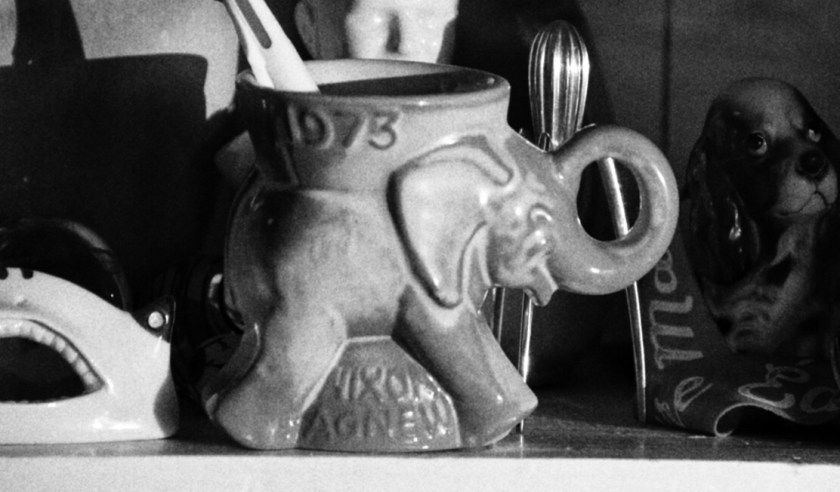
In my delirium, I’ve become fixated on this object, which sits on my desk. So fixated that I pulled out my Brownie and snapped a photo.

Fixed elephant.jpg

It’s a campaign tchotchke from the 1973 Nixon-Agnew Presidential campaign. In Park Ex, at least in Greek households, we called these things bibelots. Every horizontal surface is littered with bibelots: gondoliers, toreadors, geishas, and always and everywhere, the Parthenon cast in metal, plastic, glass, chocolate. For me, these objects exert a powerful gravitational pull. Like giant suns, they bend the contours of history and memory.

The elephant in the room

We picked up this one at a flea market and it’s made by Francoma Pottery, which we kind of collect, or at least used to.

Richard Nixon is famous for many things, besides the obvious one. Among them is his Southern Strategy, which successfully converted Southern Democrats to the Republican Party. Hammering away at restoring “law and order,” in the wake of civil rights demonstrations in the South, did the trick for a certain kind of voter. That strategy has a very long tail.

Also, Spiro Agnew — the only Greek-American politician to soar as high in U.S. politics. Agnew was from Baltimore, which has a surprisingly large Greek community. (In The Wire, there’s a side story in one of the later seasons about organized criminals on the Baltimore docks; they all speak an unconvincing Greek.)

Agnew was gaffe-prone and corrupt. He was derided mercilessly as a fool, and had a weakness for alliteration, itself a kind of linguistic bibelot. He’s best remembered for accusing journalists of being “nattering nabobs of negativism.” That, too, has a long tail. Agnew was the second Vice President in U.S. history to resign in disgrace, so he couldn’t even be first at being bad.


The snow runner

Montreal’s fresh snow and bracing cold have been positively glorious this winter. Every run is a tonic.

The Coach says it’s not about distance or time; it’s about effort. So last week I went to great effort to dress for the occasion: Merino-blend long johns under insulated running tights, a long-sleeve running shirt under a zip-up mock turtleneck, and over all that a medium-weight blue fleece topped by the red Running Club windbreaker. On my hands, dollar-store knit gloves and Thinsulate-lined mittens. And on my head a balaclava capped with a running hat.

Running with a balaclava is a challenge because I’m not entirely sure how to pronounce it. I’m tempted to say baklava, which I know is wrong on several levels. Most people pronounce it with the accent on the third syllable. But I like to hedge my bets, so as I run I chant the word balaclava, once unaccented and then progressively favouring each of its four syllables. As a running mantra it works very well in winter, transporting me to a sleek Barcelona chair in a book-lined room filled with classical music, where I sit before an open fire holding a ham sandwich…

Where were we? Oh, and on my feet I wore my regular running shoes and socks.

The temperature was –24° Centigrade with a wind chill that brought things down to –32°. But once you get going it’s fine for several minutes and then gets too hot. Suddenly you’re a salmon being poached, and despite the internal heat the moisture in your breath, trapped by the balaclava, freezes into icy shards that press against your cheeks and eventually join up with the encroaching ice from your frozen eyebrows to form one continuous layer.

Did I mention the sidewalks? There are no sidewalks. The sidewalks are under four feet of snow, so you run on the road and the drivers, careening helplessly because they have no traction, honk and stare daggers at you. You stare daggers back, but they can’t see you doing it because your glasses are fogged from your breath, causing you to miss the turn that would have taken you home an hour ago and you’re now standing in front of a concrete building you’ve never seen before. Although, helpfully, it is a hospital.


So long, Sanibel

I went for a long run the other day for the usual reason: to clear the mind. In the cool morning air, before the start of foot and bike traffic, a large sleepy snake had curled up on the asphalt to warm in the sun. Annoyed at my approach, it slithered into the underbrush. I thought the snake to be a good omen.

At the 8.3km mark of my long run, with egrets and ibises flickering through the trees on my right, and ospreys wheeling above, I experienced a spell of the runner’s euphoria others describe but I’ve never felt. By the 9km mark, the euphoria had evaporated, but I remained grateful for having seen the snake.

Wings in


Wings out

Two birds I photographed with my Brownie. My son, a tireless joker, calls every bird near or on the water a duck. Neither of these is a duck.

Christmas on Sanibel

This is the first Christmas vacation we’ve spent in the south. It’s disorienting to see people setting up miniature Christmas trees beside their beach towels, and women wearing necklaces of Christmas lights as they sun.

On one of my runs I passed a Santa-and-reindeer diorama. Someone had stuck twelve rickety metal flamingos into the dirt, adorned them with red toques and harnessed them with strings of tinsel to a massive Adirondack chair, painted red. Shuddering in the morning breeze and weighed down with their spangled reins, the poor flamingos had the sturdiness of used twist-ties. Absurdly, I felt sorry for them. The flamingos clearly weren’t up to pulling the fat man and his chair. All I could think about was #MeToo.

As I ran by, an elderly woman taking pictures kept exclaiming, “Lovely…lovely.”

Later that same day, on the beach, a boy of about twelve was wearing a t-shirt illustrated with a fishing rod and the words, “God is the REEL THING.” I was tempted to explain to him that Jesus, not God, is generally regarded as the “Fisher of men” (Matthew 4:19). But he probably would have gone running to his mother, and I’ve now learned how prickly Sanibel Islanders can be.

Further down the beach, Shari was sitting cross-legged and sketching the Sanibel Lighthouse. As my photo shows, the lighthouse lacks the picturesque romance of Maritime and New England lighthouses. Only an engineer could have come up with it: basically, a superstructure of girders supporting an iron cylinder that encloses a spiral staircase. It’s simple and ingenious and, with its reddish glow of rusting metal, actually quite attractive. A few small outbuildings are clustered at the base, with one chimney crowned by an osprey nest.

Lighthouse

As I was photographing the lighthouse, four Latino boys kicking a soccer ball stopped to watch Shari sketch. They were clearly not tourists, nor Sanibel Islanders. My guess is they were enjoying a day off from a restaurant kitchen. They stood for some time, looking approvingly over Shari’s shoulder at the sketch and glancing up at the lighthouse.

At this point a woman with two daughters — from their sound and appearance, Dutch tourists — began setting up on the sand. The comelier daughter casually stripped off her t-shirt and rummaged in a straw bag for her bathing suit top. She was well outside the boys’ field of vision, but activated by some invisible signal, four heads swivelled with impressive unison, rotating a hundred-and-eighty degrees. The heads watched impassively until the bathing suit top was secured, then snapped back into position. The boys recommenced kicking the ball down the beach.

The Miami Dolphins quarterback

One day, we took a drive to nearby Matlacha. If I were to give you five guesses, you would still be unable to come up with the correct pronunciation for this island. The locals say “Matt Lashay.” To my ear it sounds like the name of a celebrity hairdresser on the Shopping Channel or the Miami Dolphins quarterback or a televangelist (“And he saith unto them, Follow me, and I will make you fishers of men”).

It took about thirty minutes to get to Matlacha, past sprawling housing developments, followed by malls that service the developments, then tracts of empty land, then more sprawling developments and more malls to service them, and so on. We concluded that staying on Sanibel is more agreeable.

I’ll offer up one final image to cap our vacation: On the day of our leaving, crowds of Sanibel Islander came out to wish us a safe journey. Lining the entire causeway and bridge to the mainland, they beat their drums and blew their conch shells in traditional farewell, as they raised giant palm fronds to create an archway for our departure. I confess to shedding a tear or two.