After the celebration and a near-sleepless night, I stumbled into the kitchen and turned on the coffee machine, then the radio. A male voice came on. It said the Province of Alberta was in the grip of a weasels epidemic.
“The return of weasels is unprecedented,” a second voice said, sounding a note of panic. This one belonged to a doctor. “We thought weasels had been eradicated generations ago, and yet here we are again, having learned nothing.”
Driving around Tucson, Arizona last January, I noticed a surprising number of billboards for clinics specializing in vasectomy reversal. Actually, it was just two billboards, but even one would have been surprising. I mean, how many clinics can rustle up enough customers for justthis?
I’ve never had a vasectomy myself — much less its reversal — but this got me thinking.
The vasectomy seemed like a good idea. What with the kids finally in school and the house nearly paid off and whatnot. But after a couple of years the wife starts getting on my case and the kids are taking her side. There’s a bunch of yelling and whatever. So I get my own place and move on with my life. Now, there’s Summer. She’s a good kid, Summer. Put the wind in my sails again. Said she wants to have my baby. Summer doesn’t know about the vasectomy, of course, but I’ve been seeing these signs around town…
Normally I don’t dwell on regret, but I understand the temptation. At a restaurant I’m always the one looking at everyone else’s plate and thinking, “Damn, I should have ordered that.”
* * *
We are currently far from Arizona, in Rockport, Massachusetts. But just a few weeks ago we were even further away, in the French Alps, at a small hotel that normally offers a spectacular view of Mont Blanc. I say normally because the promised mountain was just a ghostly shape when we arrived, barely registering behind a damp and dreary sky. We looked for it, somewhere up there, above the turquoise hotel pool, and saw only an approximation of mountain, maybe right about there. It put me in mind of faith; of waiting for someone in robes to manifest among the clouds.
At breakfast a fellow guest said that wildfires in Western Canada were responsible for the haze. Over the past several years, we’ve noticed an increasing number of Americans, eyes brimming with regret, giving us long, meaningful looks and sorrowful apologies. I’ve never seen a people so contrite. And here at last was our turn to apologize, even though no one blamed us, personally, for ruining the view.
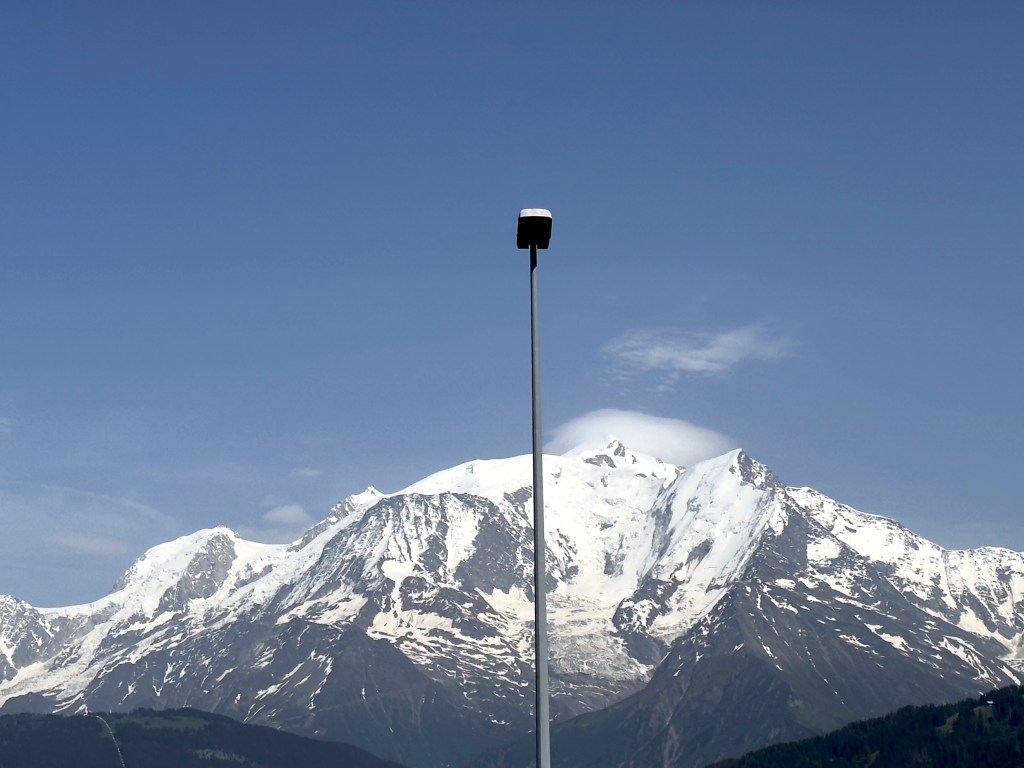
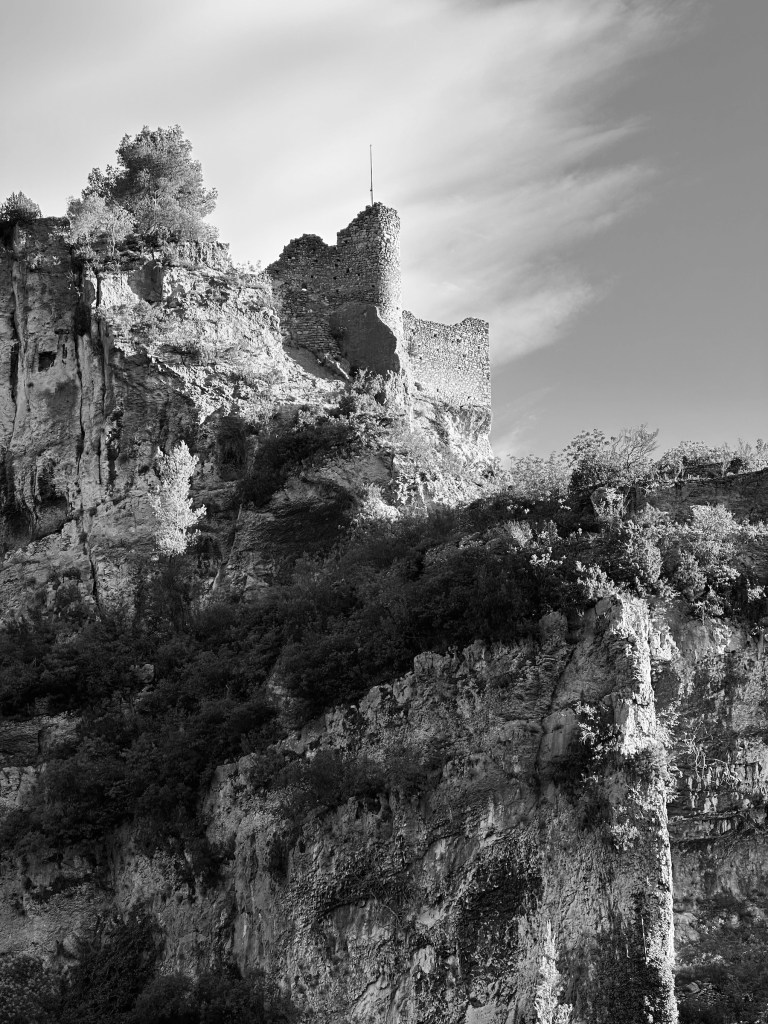
In the second week the smoke gradually cleared and one fine morning there it was. It’s not always in sight, but you turn a corner, look up, and there it is again — Mont Blanc. A black and white immensity. Ancient, primeval, severe, towering above the green hills and tidy Alpine chalets. It’s all a bit unreal, and doesn’t seem to fully belong in our freshly-painted world.
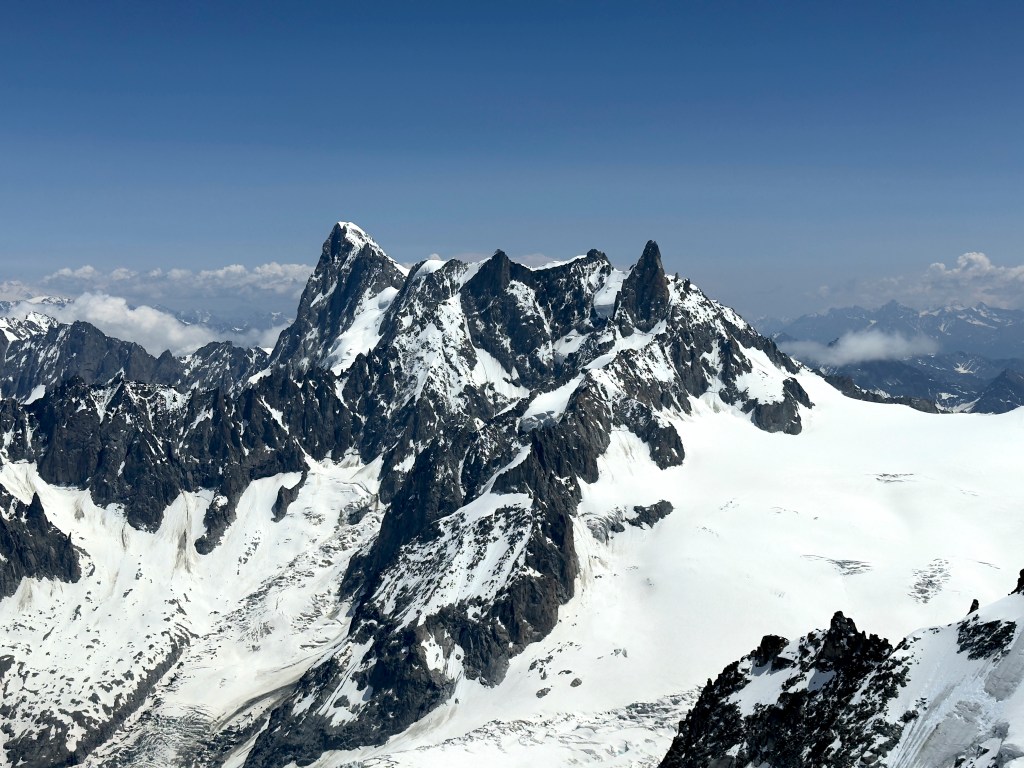
During our trip we took a gondola and cable car up to the Mont Blanc massif. We were lightheaded by the altitude and intoxicated by the view. It is the face of God, I heard someone say.
Later on we spent a day at Megève, a small Alpine town that swells with the ultra-rich during ski season. Many of the high-calibre shops, restaurants and real estate offices were shuttered, but you wander around and quickly get the idea. Megève was founded in 1920 by Baroness Noémie de Rothschild, and there’s a respectful monument to that rich lady you might gaze at for some moments.
There’s also a monument to Jacques Revaux, who lived here for a time. Revaux co-wrote Come d’habitude, which in 1967 went #1 on the French hit parade for singer Claude Francois. Paul Anka heard the song while vacationing in the South of France and immediately thought it would be perfect for Frank Sinatra. Anka bought the rights, left the melody nearly intact, and wrote entirely different lyrics. (You know the song; you’ve heard it a thousand times; you may, like some people, hate it. But it’s still a master class in lyric writing.)
Sinatra recorded My Way in one take, in 1969, and it sold millions. It’s Sinatra’s biggest hit: a man’s sentimental hymn to bloated self-regard. It is the Mont Blanc of songs. (I’m surprised they don’t play it at political rallies.) Two other songs from about the same era also come to mind: Paul Anka’s You’reHaving my Baby (1974), for which he got into plenty of hot water. And It’s a Man’s Man’s Man’s World (1968), by James Brown. But My Way towers above the rest.
Regrets, I’ve had a few,
But then again, too few to mention…
As it turns out, there’s an earlier English version of Comme d’habitude, by David Bowie. It was never recorded. A couple of years after My Way’s release, though, Bowie reworked his translation (which actually sticks pretty close to the French) into Is There Life on Mars? from his Hunky Dory album. He always hated My Way.
A corner of Megève in the off-season.
* * *
Our trip to the French Alps began in Geneva, where we stayed for a couple of days to recover from jet lag. The city is graceful, orderly, eager to take your money. If Geneva has a face, it is the face of a Rolex watch. In fact, the parade of luxury watch brands begins right at the airport and follows you everywhere. Their logos dominate the Geneva skyline, where they perch atop every tall building like golden gargoyles, watching your every move.
On our second day in Geneva, as we were crossing one of the many bridges that span the Rhône River, we encountered a demon.
It was only a brief moment, mind you. We were walking in opposite directions, so I couldn’t say what the demon was wearing. But I can tell you that every square inch of skin was tattooed, and tattooed horribly — a pudding of muddy browns, greens and blues pierced only by the whites of his eyes. And something else, too. The face had been altered by props or skewers, maybe a botched surgery. Maybe a bone through the nose.
In our history books at school, I remember prints made from explorers’ descriptions of painted savages from the Americas and Africa. Today most of us think of these images as misapprehensions: ignorant, racist, fearful first impressions of the other. Nothing education and open minds can’t clear up — at least that’s what most of us think.
At dinner one night, in our snug hotel under the shadow of Mont Blanc, we described the demon to other guests at our table. The big question, of course, is why would anyone do this to himself? Tattoos on this scale are, unlike a vasectomy, irreversible. If he has regrets, too bad for the demon on the bridge.
As it happened, there was a psychiatrist at our table, and she had seen a patient who had been heavily tattooed and pierced
“It’s all about control,” said the psychiatrist. “If you don’t like how others see you, tattoos put you back in charge. You force others to see only the tattoos.”
She was right, I suppose. For all I know the demon was wearing a Speedo and ballet slippers. I saw only the tattoos.
But I saw something else, too. If I’m being honest, I saw a painted guy with a bone through his nose coming my way and I didn’t like the looks of him. He scared me, and I don’t know exactly why. I’m fully prepared to be wrong about him. About all those who remain demons among us — strangers, every one of them.
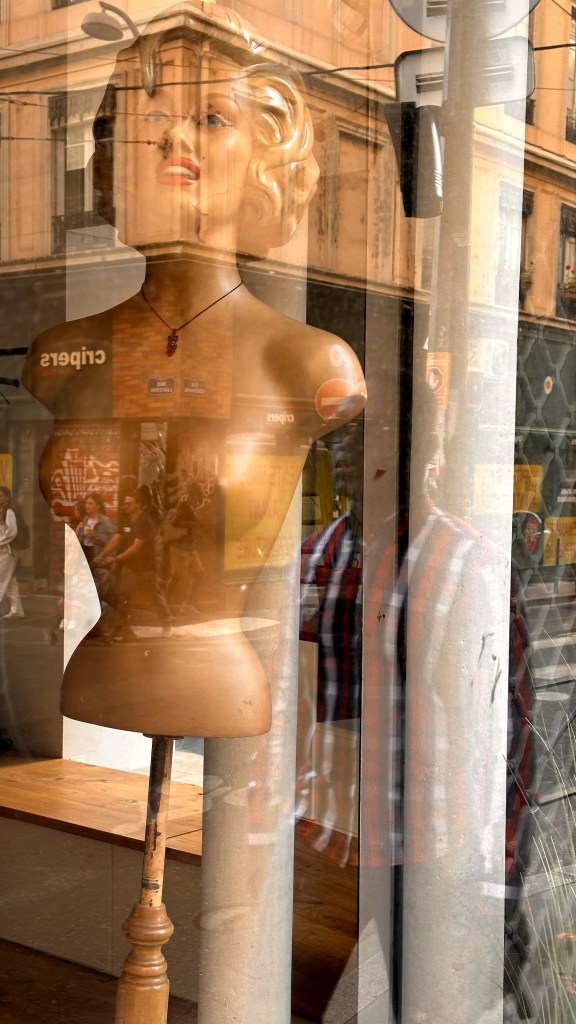
But it’s hard, especially when I look in a mirror. What do I see there? Regretfully, I see two faces from Geneva. One of them symmetrical, orderly, precise. And this.
Taken outside a shuttered boutique in Megève. Why else would you abuse your body? Because it’s a blank canvas, a stage, a means to express yourself. And because it is, after all, yours.
I’m reading an English translation of The Flaw, a Greek mystery thriller by Antonis Samarakis. That characterization, mystery thriller, isn’t quite right. In fact, the book does not fit into any single category. It’s just too strange and funny and destabilizing. It dwells on banal events, some of which later turn out to be not so banal. Flits between one character’s point of view and another’s. Never pretends to know what any character is thinking or feeling, which leaves you wondering that you’re thinking and feeling. About the book, I mean.
As we entered To Mikro Karavi (The Little Boat), a bookstore on Daskalogianni Street, Maria Callas — I assumed it was Maria Callas — was deep into some aria. I could see her at stage front, shattered, bloodied, defiant. Callas was cranked up so loud you couldn’t hear yourself think.
From my high vantage, I have a bird’s-eye view of the town of Bar Harbor, Maine and of the ugly cruise ship parked half a mile out and waiting for its humans, who are now scattered up and down Main Street buying oven mitts and bacon jam.
As I write this at an iron table in the South of France, a donkey is bawling his eyes out behind a stone wall. Meanwhile to my right and left, streams of churning water tumble and rush south on their way to the Mediterranean.
We are in Lyon, the food capital of France, eating with chopsticks. We ate at an Asian restaurant last night as well, and will ask for chopsticks again tomorrow, at a place where the steamed buns and barbecue pork belly, with a side of kimchi, are especially good.
I walked up and down Ocean Street in Carmel by the Sea looking for a place to buy a hot dog but came up empty. You can’t find a hot dog on the side streets either, and that’s too bad. But there is a whole lot else in Carmel to enjoy, arguably far better than a hot dog.
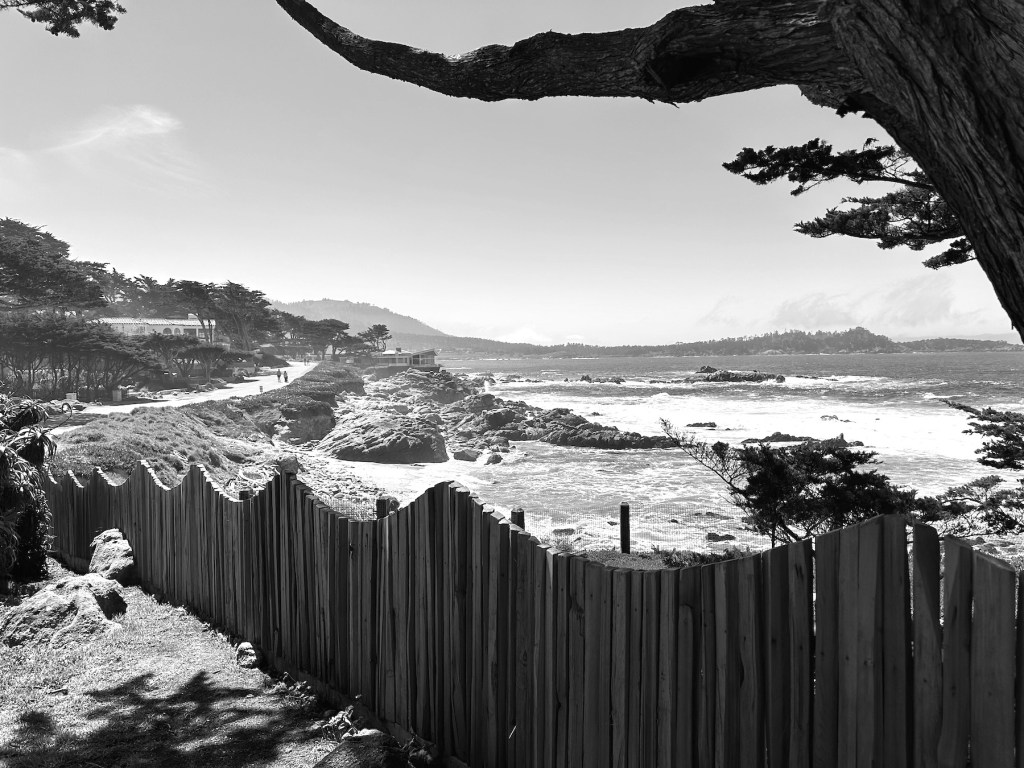
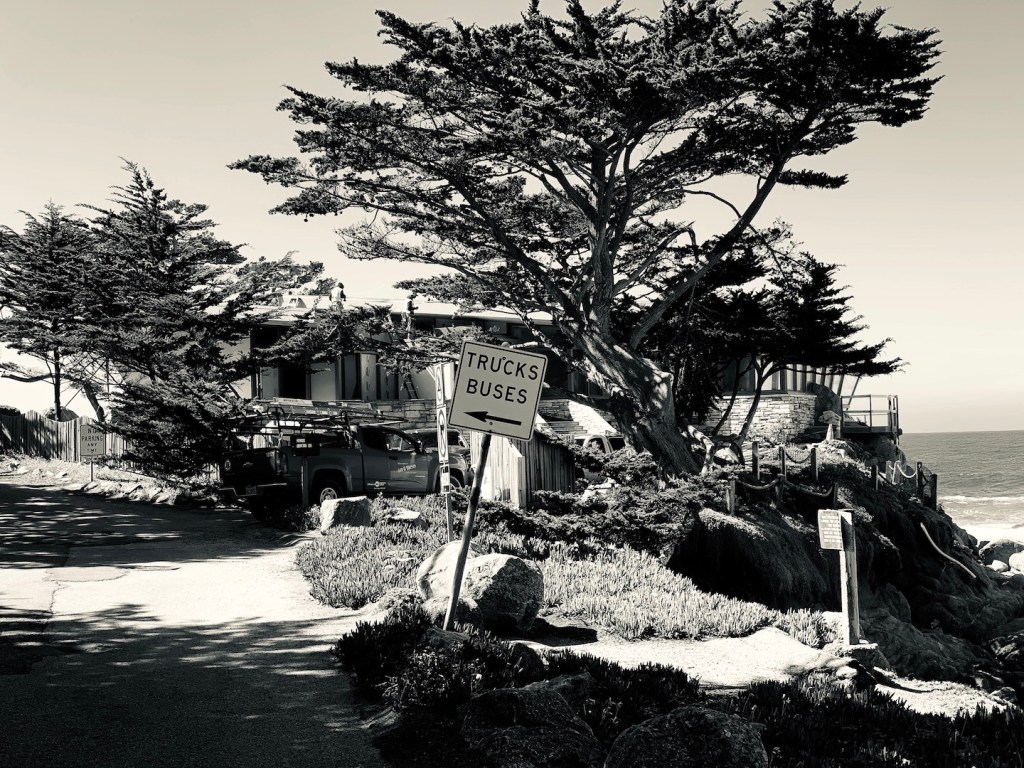
Carmel by the Sea is a pretty swell town. You run down steep Ocean Avenue to the very bottom and catch your breath at the brimming sea, the sound of crashing waves and unexpectedly turquoise waters. You turn left at the scenic road, unimaginatively called Scenic Road, and run past plenty of expensive houses facing the ocean, including one house designed by Frank Lloyd Wright. A real beauty. You see middle-aged and elderly surfer dudes pulling their boards from their vans, gawkers in their Honda Civics, gardeners and carpenters and plasterers parked every which way, tending to the perfection of each house. Everyone wants to live here and you can see why.
Yesterday I learned that Brad Pitt, a movie actor, just bought a house in Carmel for forty million dollars. It’s somewhere up in the hills. Most expensive houses are invariably up in the hills, or on the coast.
Alas, Carmel is also weighed down by plenty of rules. For instance, one bylaw says that women cannot walk on city streets in high heels. (Doesn’t say anything about men, though.) The law specifies the height and width of the offending heels. To my mind none of this makes much sense, because you can find any number of fine-looking pairs of women’s high heeled shoes in the shops around town. You just can’t wear them outdoors. But then it gets even loopier. This being a free country, you can go to city hall and get a certificate that gives you a temporary exemption. The certificate is free.
There was another law, too, about ice cream cones: Not allowed, on account of the mess they make on the sidewalks. But when Clint Eastwood, an actor, became mayor of Carmel in the late eighties, he immediately struck down that law. In fact he campaigned on doing exactly that. The restriction on high heels still stands.
One of the fine looking houses on Scenic Road.
Yesterday we found ourselves browsing the menu outside a steak restaurant. It had high ceilings and great big windows, and looked like it could easily seat two hundred people. It was early and still eerily empty. Most steaks were in the sixty to seventy-dollar range, with one topping out at ninety dollars. These are U.S. dollars, mind. If you want a side of brussels sprouts, that will set you back sixteen dollars. A potato, eighteen dollars. It was cold when we were reading the menu and we were shivering. What would stop us from entering the heated restaurant and ordering up a plate of brussels sprouts, with two forks, and a glass of water? After all, this is a free country.
* * *
When I was in my adolescence, a distant cousin of my father’s came to visit us in Montreal, and as he stepped out of his Cadillac he handed me a hundred-dollar bill. That was when a hundred dollars really meant something. Until then, I had no idea there were such people and that these people were so very nice.
A few years later, when we visited that distant relative in the States, he asked me what I’d like to drink. He asked me from the other side of a bar in his impressive home. I remembered the hundred dollars and the Cadillac and for some reason wanted him to believe I knew a thing or two about drinking and about living large, so I asked for Metaxa brandy, seven-star, neat. He pulled out an unopened bottle of 50-year-old Metaxa, a bottle I had not known existed. He broke the seal and poured me a stiff one.
While in Carmel, I am rereading the short stories of Ernest Hemingway. I gave away my paperback copy of his complete stories a long time ago. And the only reason I’m reading them again now is because they just entered the public domain and cost only ninety-nine cents to download. They are worth the revisit.
In “The Snows of Kilimanjaro,” Hemingway says that another American writer, whom he declines to name, wrote somewhere that “the rich are different from you and me.” Of course they are, he writes. They have more money. The writer Hemingway declined to name was F. Scott Fitzgerald, who was besotted with the rich.
The streets in Carmel by the Sea are paved with gold and its fairy tale cottages studded with precious stones the size of grapefruit. The skies are always blue and the people here, God bless ‘em, live forever.
The House of Prayer, occupied by the Sisters of Notre Dame de Namur, next to the Carmelite Monastery. Both are in the Santa Lucia foothills, facing the sea and the fancy houses of Carmel.

 because i said