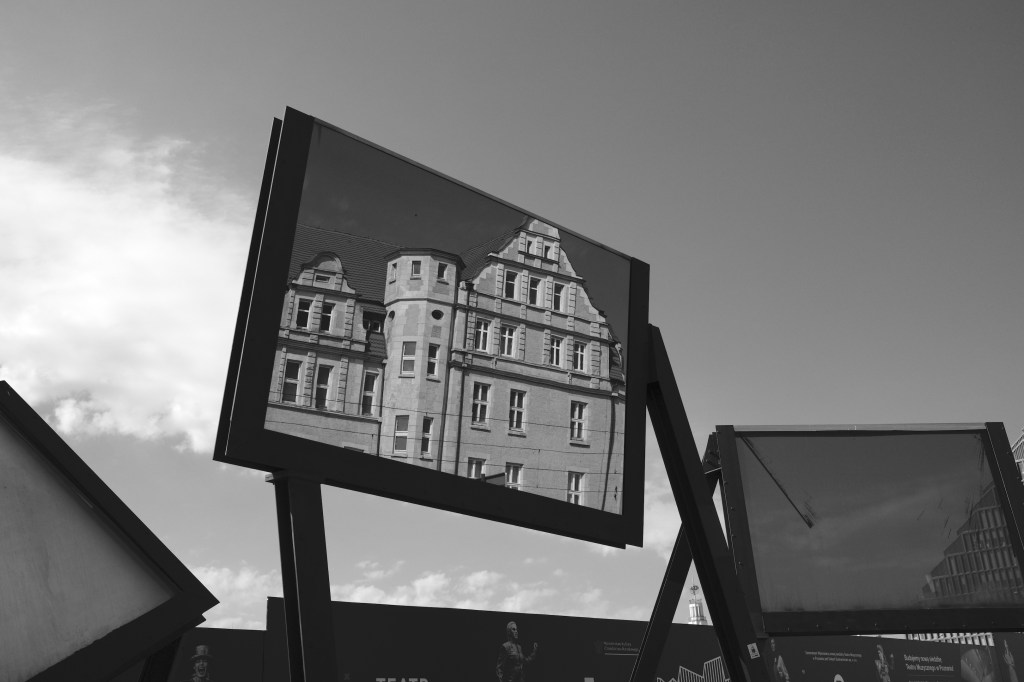
Taken while walking on a street in Poznan. The black frames hold mirrors reflecting skies and buildings. I suspect this is a work of public art, although I found no identifying plaque.
In most countries folks celebrate all the good bits in their history with parades. You get drunk, sing songs (everyone knows the words; it’s how you belong) and, with much good cheer, you remember.
In most countries, as you may have noticed, the very same people work just as hard at forgetting the bad bits in their history. Or at least they try to erase as much evidence as they can, so the younger folk will have a simpler, kinder view of an always complicated history.
Anything special happen this week? Well, sir, as we leave our pink adobe cassita at the dude ranch one morning, I see a grey bunny, nose in the air, sniffing. I take this for a good sign.
Later, on my way to hike the Douglas Spring Trail, which begins less than a kilometre from the ranch, a road runner eyes me suspiciously from beneath a large mesquite. The mesquite is all elbows, and in its branches sits a scarlet tanager. More good signs. But alas, no Gila monsters anywhere to be seen. Still on the lookout for those.
After a few days in London (see photo above), we took the train from King’s Cross station to King’s Lynn in Norfolk. From there, a half-hour’s drive took us to the northern edge of Norfolk, and beyond that, a grey sea.
Beautiful country, this, even under an overcast sky. At low tide the beaches go on forever, with a scattering of angled boats at rest on the sand, and a distant horizon that is an approximation in the misty light. If you possess an excellent imagination and look really hard, you’ll see Holland straight across.
I go for a run on a windy day, along a narrow road flanked by fields of yellow stubble. From the windbreak beside me rises a hawk and, hanging from its cruel beak, a snake. A sudden gust sweeps the hawk from view and it soon disappears into the sky. I take this for a sign, even though I don’t believe in signs.
I don’t believe in signs because, as the years pass and the world sinks ever lower, I find myself losing faith in any kind of meaning. Time lurches on, events pile up, that’s it.
Sandringham, Sir
We’re not far from Sandringham House, in Norfolk, where Queen Elizabeth II spent every Christmas, and from where she delivered her annual Christmas message. She usually stayed until February. Sandringham (20,000 acres) was one of her two private residences, the other being Balmoral Castle in Scotland (53,000 acres). This is to distinguish these properties from Buckingham Palace and Windsor Castle, which belong to the state. Now all of this goes to Charles.
Sandringham is sporting: horses, dogs, shooting, cards. A life-size bronze statue of Estimate, the Queen’s favourite horse, stands out front. Inside, should you be invited, there’s a gun room and a billiards room. There was also a bowling alley which, alas, is now a library.
Soon after arriving in Norfolk, we spent a day at the Sandringham Game & Country Fair. Country fairs are like happy families: all alike and loads of fun. Chainsaw carving, a Ferris wheel, falconry, men striding about swinging swords. And dogs, plenty of dogs, along with ferrets, miniature steam engines and antique cars. And always, from somewhere else on the fairgrounds, a continuous pop-pop-pop. For there is shooting as well.
William and Kate have a house near Sandringham, and are sometimes spotted going about their business. With all this royalty and gentry and hangers-on close at hand, small wonder that at Sandringham Game & Country Fair, you notice a sprinkling of hearty folks in Harris tweed or Burberry or Prada, among the young families with missing teeth, tattoos and half-naked kids.
Wandering through various odds and ends at the fair, I came across a display of large petrol cans from the previous century. The cans were spotless, paint still bright and hopeful, and ranged on a specially built frame: five cans tall by nine wide, forming a kind of wall. Some logos were familiar, even if outdated: Esso, Mobil and Shell. But also the unfamiliar Glico, National Benzole and Wimpey.
A glum-looking older chap in a lawn chair sat beneath his wall of petrol cans. He didn’t react when I pointed at my camera and then at his display. But as I raised my camera, he ever so slightly squared his shoulders.
Cameras will do that.
Sir Elton
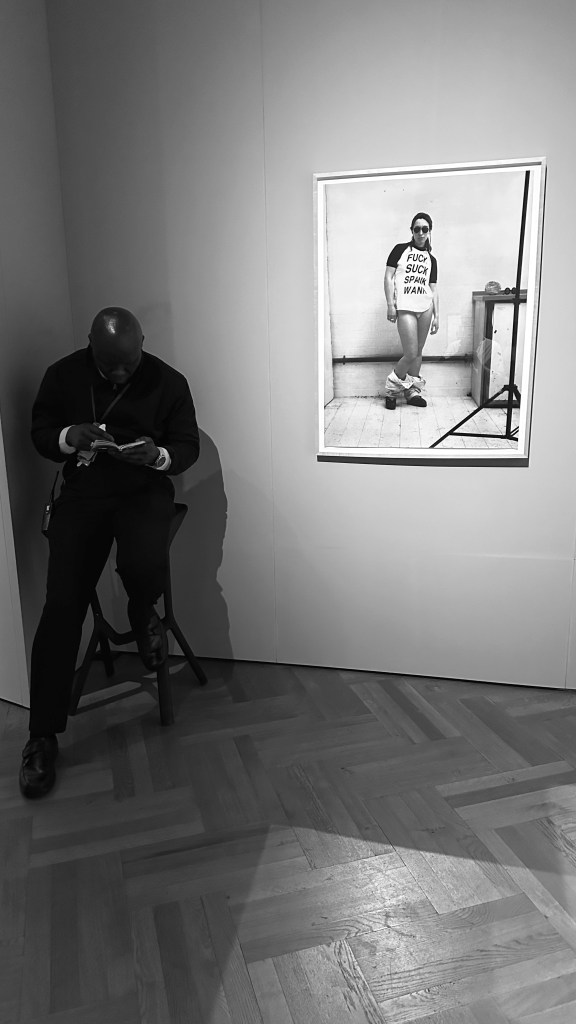
As I say, cameras will do that, and do many other things. At the Victoria & Albert Museum, in London, we saw “Fragile Beauty,” an exhibition of photographs from the collection of Sir Elton John and David Furnish. Elton and David have been collecting for years, and now own one of the foremost collections in the world (7,000 photos total, only 300 in the show). As expected, we saw plenty of fashion, celebrity and gay-themed images (often interesting, sometimes beautiful), but also street photography, reportage and conceptual photos (far more interesting). One image, of a man plunging to his death from the World Trade Center, haunts everyone who sees it.
At the Victoria & Albert, to see “Fragile Beauty: Photographs from the Sir Elton John and David Furnish Collection.”
I bought the exhibition catalogue to “Fragile Beauty,” which I’m now happy to lend. Later on during our trip, as a palate cleanser to all this plunging-to-his-death stuff, I also bought a handsome book of photographic portraits of Queen Elizabeth II. On every page, she looks like money.
Then, on our final evening in London we went to see Coriolanus at the Royal National Theatre, with the astounding David Oyelowo in the title role. I read the play at university, but of course remembered not a thing (and still don’t). For some reason we had managed to snag seats in the third row, and so this ingenious production was literally in our faces. Across the stage, marble busts reminded us of Rome and its politics. There was a sword fight, but also business suits and a camera crew, bringing the politics to the present.
Here was a tragedy of a great man who, despite his greatness, is trapped within his own limitations, unable to see or to change. I suppose that, minus the greatness, that could be any one of us.
At the Laurence Olivier Theatre, moments before the start of Coriolanus.
* * *
With the hawk gone, I stare into the now empty sky above a field of yellow stubble. Then, as I continue my run along the narrow country road, a doe and two fawns emerge from the blackberry bushes up ahead. I stop, but they’ve already seen me. The faintest sound of tapping, as the doe and fawns tiptoe nervously across the asphalt and vanish into the opposite bushes. More signs, perhaps.

 because i said