Anything special happen this week? Well, sir, as we leave our pink adobe cassita at the dude ranch one morning, I see a grey bunny, nose in the air, sniffing. I take this for a good sign.
Later, on my way to hike the Douglas Spring Trail, which begins less than a kilometre from the ranch, a road runner eyes me suspiciously from beneath a large mesquite. The mesquite is all elbows, and in its branches sits a scarlet tanager. More good signs. But alas, no Gila monsters anywhere to be seen. Still on the lookout for those.
From my high vantage, I have a bird’s-eye view of the town of Bar Harbor, Maine and of the ugly cruise ship parked half a mile out and waiting for its humans, who are now scattered up and down Main Street buying oven mitts and bacon jam.
After a few days in London (see photo above), we took the train from King’s Cross station to King’s Lynn in Norfolk. From there, a half-hour’s drive took us to the northern edge of Norfolk, and beyond that, a grey sea.
Beautiful country, this, even under an overcast sky. At low tide the beaches go on forever, with a scattering of angled boats at rest on the sand, and a distant horizon that is an approximation in the misty light. If you possess an excellent imagination and look really hard, you’ll see Holland straight across.
I go for a run on a windy day, along a narrow road flanked by fields of yellow stubble. From the windbreak beside me rises a hawk and, hanging from its cruel beak, a snake. A sudden gust sweeps the hawk from view and it soon disappears into the sky. I take this for a sign, even though I don’t believe in signs.
I don’t believe in signs because, as the years pass and the world sinks ever lower, I find myself losing faith in any kind of meaning. Time lurches on, events pile up, that’s it.
Sandringham, Sir
We’re not far from Sandringham House, in Norfolk, where Queen Elizabeth II spent every Christmas, and from where she delivered her annual Christmas message. She usually stayed until February. Sandringham (20,000 acres) was one of her two private residences, the other being Balmoral Castle in Scotland (53,000 acres). This is to distinguish these properties from Buckingham Palace and Windsor Castle, which belong to the state. Now all of this goes to Charles.
Sandringham is sporting: horses, dogs, shooting, cards. A life-size bronze statue of Estimate, the Queen’s favourite horse, stands out front. Inside, should you be invited, there’s a gun room and a billiards room. There was also a bowling alley which, alas, is now a library.
Soon after arriving in Norfolk, we spent a day at the Sandringham Game & Country Fair. Country fairs are like happy families: all alike and loads of fun. Chainsaw carving, a Ferris wheel, falconry, men striding about swinging swords. And dogs, plenty of dogs, along with ferrets, miniature steam engines and antique cars. And always, from somewhere else on the fairgrounds, a continuous pop-pop-pop. For there is shooting as well.
William and Kate have a house near Sandringham, and are sometimes spotted going about their business. With all this royalty and gentry and hangers-on close at hand, small wonder that at Sandringham Game & Country Fair, you notice a sprinkling of hearty folks in Harris tweed or Burberry or Prada, among the young families with missing teeth, tattoos and half-naked kids.
Wandering through various odds and ends at the fair, I came across a display of large petrol cans from the previous century. The cans were spotless, paint still bright and hopeful, and ranged on a specially built frame: five cans tall by nine wide, forming a kind of wall. Some logos were familiar, even if outdated: Esso, Mobil and Shell. But also the unfamiliar Glico, National Benzole and Wimpey.
A glum-looking older chap in a lawn chair sat beneath his wall of petrol cans. He didn’t react when I pointed at my camera and then at his display. But as I raised my camera, he ever so slightly squared his shoulders.
Cameras will do that.
Sir Elton
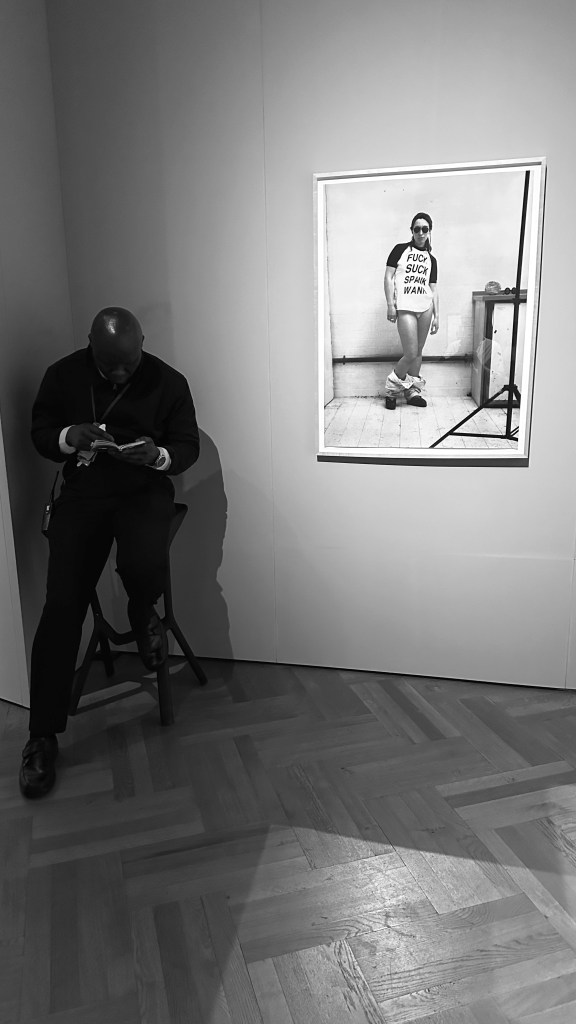
As I say, cameras will do that, and do many other things. At the Victoria & Albert Museum, in London, we saw “Fragile Beauty,” an exhibition of photographs from the collection of Sir Elton John and David Furnish. Elton and David have been collecting for years, and now own one of the foremost collections in the world (7,000 photos total, only 300 in the show). As expected, we saw plenty of fashion, celebrity and gay-themed images (often interesting, sometimes beautiful), but also street photography, reportage and conceptual photos (far more interesting). One image, of a man plunging to his death from the World Trade Center, haunts everyone who sees it.
At the Victoria & Albert, to see “Fragile Beauty: Photographs from the Sir Elton John and David Furnish Collection.”
I bought the exhibition catalogue to “Fragile Beauty,” which I’m now happy to lend. Later on during our trip, as a palate cleanser to all this plunging-to-his-death stuff, I also bought a handsome book of photographic portraits of Queen Elizabeth II. On every page, she looks like money.
Then, on our final evening in London we went to see Coriolanus at the Royal National Theatre, with the astounding David Oyelowo in the title role. I read the play at university, but of course remembered not a thing (and still don’t). For some reason we had managed to snag seats in the third row, and so this ingenious production was literally in our faces. Across the stage, marble busts reminded us of Rome and its politics. There was a sword fight, but also business suits and a camera crew, bringing the politics to the present.
Here was a tragedy of a great man who, despite his greatness, is trapped within his own limitations, unable to see or to change. I suppose that, minus the greatness, that could be any one of us.
At the Laurence Olivier Theatre, moments before the start of Coriolanus.
* * *
With the hawk gone, I stare into the now empty sky above a field of yellow stubble. Then, as I continue my run along the narrow country road, a doe and two fawns emerge from the blackberry bushes up ahead. I stop, but they’ve already seen me. The faintest sound of tapping, as the doe and fawns tiptoe nervously across the asphalt and vanish into the opposite bushes. More signs, perhaps.
As I write this at an iron table in the South of France, a donkey is bawling his eyes out behind a stone wall. Meanwhile to my right and left, streams of churning water tumble and rush south on their way to the Mediterranean.
We are in Lyon, the food capital of France, eating with chopsticks. We ate at an Asian restaurant last night as well, and will ask for chopsticks again tomorrow, at a place where the steamed buns and barbecue pork belly, with a side of kimchi, are especially good.
I walked up and down Ocean Street in Carmel by the Sea looking for a place to buy a hot dog but came up empty. You can’t find a hot dog on the side streets either, and that’s too bad. But there is a whole lot else in Carmel to enjoy, arguably far better than a hot dog.
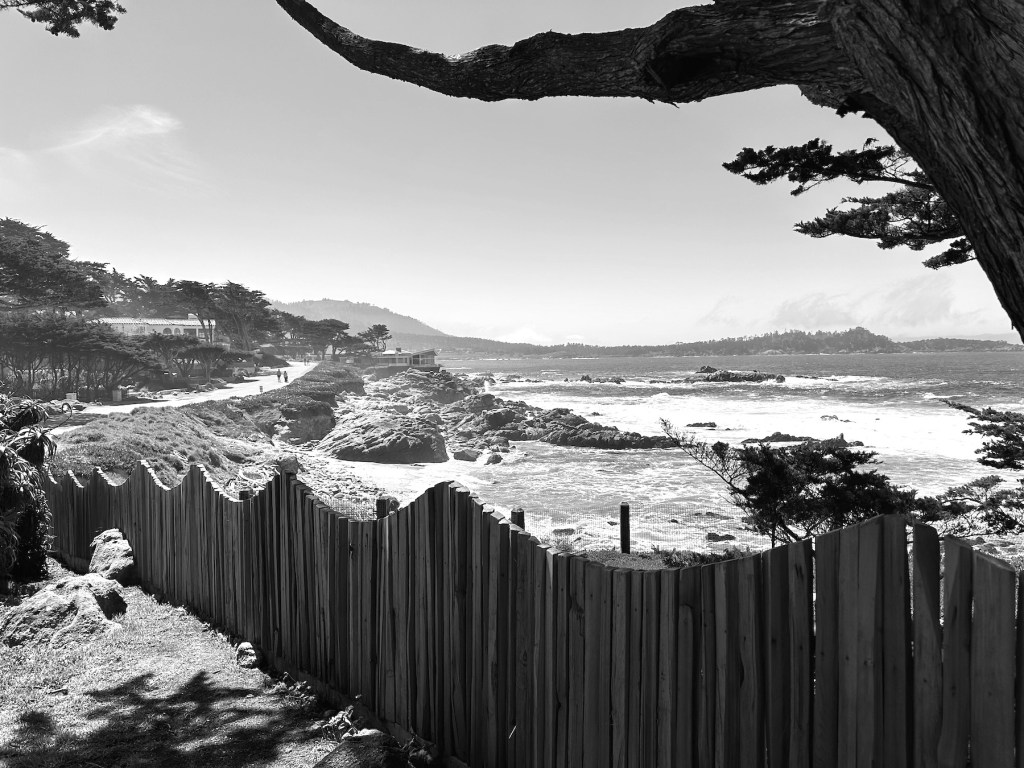
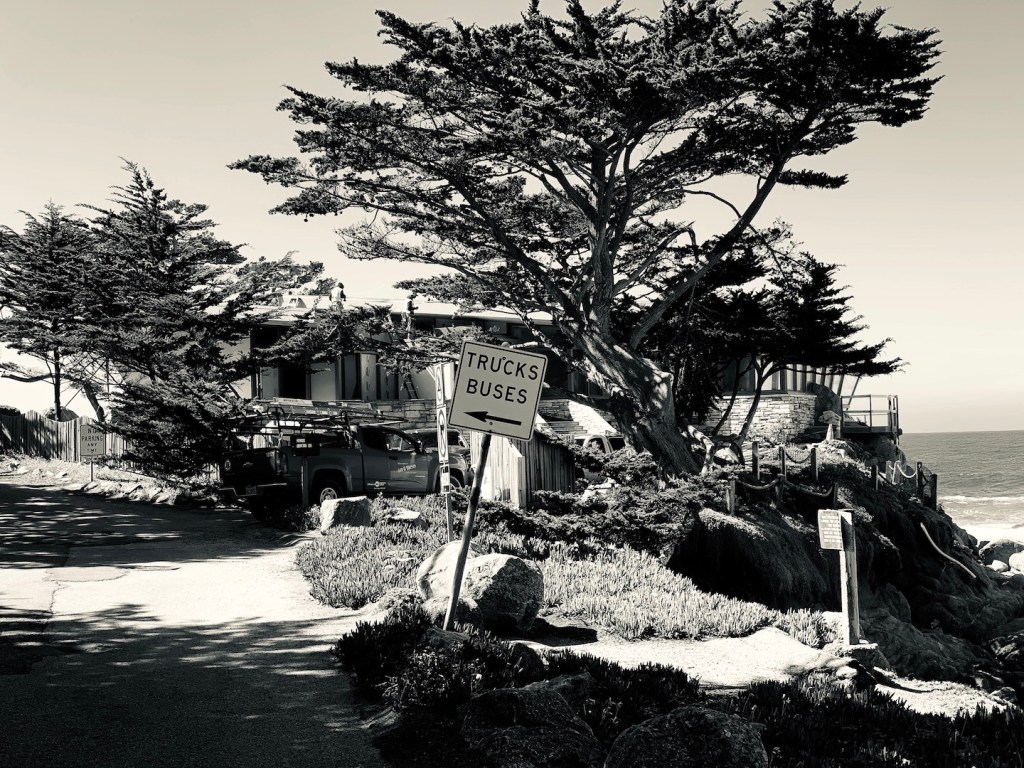
Carmel by the Sea is a pretty swell town. You run down steep Ocean Avenue to the very bottom and catch your breath at the brimming sea, the sound of crashing waves and unexpectedly turquoise waters. You turn left at the scenic road, unimaginatively called Scenic Road, and run past plenty of expensive houses facing the ocean, including one house designed by Frank Lloyd Wright. A real beauty. You see middle-aged and elderly surfer dudes pulling their boards from their vans, gawkers in their Honda Civics, gardeners and carpenters and plasterers parked every which way, tending to the perfection of each house. Everyone wants to live here and you can see why.
Yesterday I learned that Brad Pitt, a movie actor, just bought a house in Carmel for forty million dollars. It’s somewhere up in the hills. Most expensive houses are invariably up in the hills, or on the coast.
Alas, Carmel is also weighed down by plenty of rules. For instance, one bylaw says that women cannot walk on city streets in high heels. (Doesn’t say anything about men, though.) The law specifies the height and width of the offending heels. To my mind none of this makes much sense, because you can find any number of fine-looking pairs of women’s high heeled shoes in the shops around town. You just can’t wear them outdoors. But then it gets even loopier. This being a free country, you can go to city hall and get a certificate that gives you a temporary exemption. The certificate is free.
There was another law, too, about ice cream cones: Not allowed, on account of the mess they make on the sidewalks. But when Clint Eastwood, an actor, became mayor of Carmel in the late eighties, he immediately struck down that law. In fact he campaigned on doing exactly that. The restriction on high heels still stands.
One of the fine looking houses on Scenic Road.
Yesterday we found ourselves browsing the menu outside a steak restaurant. It had high ceilings and great big windows, and looked like it could easily seat two hundred people. It was early and still eerily empty. Most steaks were in the sixty to seventy-dollar range, with one topping out at ninety dollars. These are U.S. dollars, mind. If you want a side of brussels sprouts, that will set you back sixteen dollars. A potato, eighteen dollars. It was cold when we were reading the menu and we were shivering. What would stop us from entering the heated restaurant and ordering up a plate of brussels sprouts, with two forks, and a glass of water? After all, this is a free country.
* * *
When I was in my adolescence, a distant cousin of my father’s came to visit us in Montreal, and as he stepped out of his Cadillac he handed me a hundred-dollar bill. That was when a hundred dollars really meant something. Until then, I had no idea there were such people and that these people were so very nice.
A few years later, when we visited that distant relative in the States, he asked me what I’d like to drink. He asked me from the other side of a bar in his impressive home. I remembered the hundred dollars and the Cadillac and for some reason wanted him to believe I knew a thing or two about drinking and about living large, so I asked for Metaxa brandy, seven-star, neat. He pulled out an unopened bottle of 50-year-old Metaxa, a bottle I had not known existed. He broke the seal and poured me a stiff one.
While in Carmel, I am rereading the short stories of Ernest Hemingway. I gave away my paperback copy of his complete stories a long time ago. And the only reason I’m reading them again now is because they just entered the public domain and cost only ninety-nine cents to download. They are worth the revisit.
In “The Snows of Kilimanjaro,” Hemingway says that another American writer, whom he declines to name, wrote somewhere that “the rich are different from you and me.” Of course they are, he writes. They have more money. The writer Hemingway declined to name was F. Scott Fitzgerald, who was besotted with the rich.
The streets in Carmel by the Sea are paved with gold and its fairy tale cottages studded with precious stones the size of grapefruit. The skies are always blue and the people here, God bless ‘em, live forever.
The House of Prayer, occupied by the Sisters of Notre Dame de Namur, next to the Carmelite Monastery. Both are in the Santa Lucia foothills, facing the sea and the fancy houses of Carmel.
On our drive to the Titan II Missile Museum in Arizona, which served as a grim reminder of humanity’s brush with total annihilation, I was reminded of Mr. Peanut.
High wispy clouds in a brilliant blue sky. Purply mountains in the distance. A red bird in a tree, flitting branch to branch. Looks like a male cardinal. But as I get closer, the markings are all wrong. A bit smaller, too, and missing the familiar crest.
At that moment, a wrangler in boots, chaps and a white multi-gallon hat is coming my way, so I flag him down.
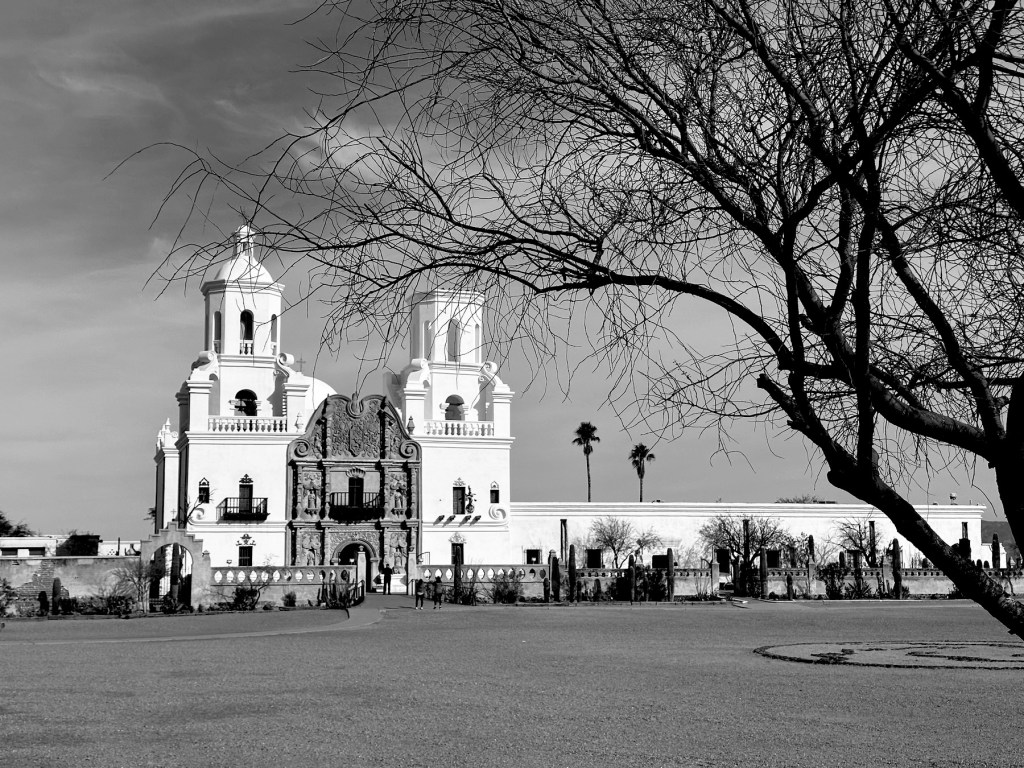
Mission St. Xavier del Bac, the oldest European building in Arizona. It’s a pilgrimage site, and you can see why. Spanish baroque, without a hint of locally inspired design. Its mission is done.
As I leave for today’s run, I spot an odd contraption on the back of a red Tacoma pickup. I draw closer to investigate, and the contraption turns out to be a wild turkey — a male, vast and spherical, with a tiny red and blue head. He stands on the pickup’s tonneau cover, regarding me with a kind of rage. As I step closer, he shows signs of alarm, even though he can plainly see I’m not holding a knife and fork. Hopping onto the roof of the cab, the turkey empties his bowel, glaring at me with small cruel eyes. On my return an hour later, a road runner crosses the road just ahead. Don’t ask me why he crossed the road.





 because i said