I’m reading an English translation of The Flaw, a Greek mystery thriller by Antonis Samarakis. That characterization, mystery thriller, isn’t quite right. In fact, the book does not fit into any single category. It’s just too strange and funny and destabilizing. It dwells on banal events, some of which later turn out to be not so banal. Flits between one character’s point of view and another’s. Never pretends to know what any character is thinking or feeling, which leaves you wondering that you’re thinking and feeling. About the book, I mean.
The Flaw was published in 1965, two years before a right-wing military junta seized control of Greece. They ruled until 1974.
I don’t have much time to read or write while we’re in Crete, but a few minutes with this book every night before bed just might keep me fed.
***
Walking around the old Venetian port one day, dodging tourists (a dreaded cruise ship was docked at nearby Souda Bay), we saw posters for the Fourth Mikis Theodorakis International Chess Tournament. It was being held in the Grand Arsenal, a handsome stone building dating from 1585, and now given over to exhibitions and a museum of architecture. I never realized Theodorakis played chess, so I googled it. Nothing, no apparent connection.
I wondered if the organizers were simply using celebrity name recognition to drum up interest. Like, when you buy a George Foreman Grill only because you know George Foreman had the ability to beat the shit out of other big people. In which case, any number of attendance-boosting celebrity tie-ins come to mind. Say, the Fifth International Sigmund Freud Pickleball Invitational. Or the Greta Thunberg Stock Car Whooperee.
I cite name recognition knowing full well that for many people — most people, I’m sure — the name Mikis Theodorakis draws a blank. He wrote the score for the movie Zorba the Greek, but also wrote much better music than that. In fact, he was Greece’s greatest composer of the twentieth century. He studied music in Paris, wrote symphonies, chamber music, ballets and operas, and was well launched on a classical music career. But then he decided to return home and devote his life to Greek popular song, music and poetry: Bouzouki instead of bassoon.
He’s also famous for his politics. Theodorakis joined the Resistance during the Second World War, took sides in the Greek Civil War, and opposed the military junta. At which point the junta banned his music and he went into hiding. You could be arrested simply for owning his records, never mind playing them on your balcony. Theodorakis was beaten up, buried alive, jailed and exiled, and still managed to be ridiculously prolific.
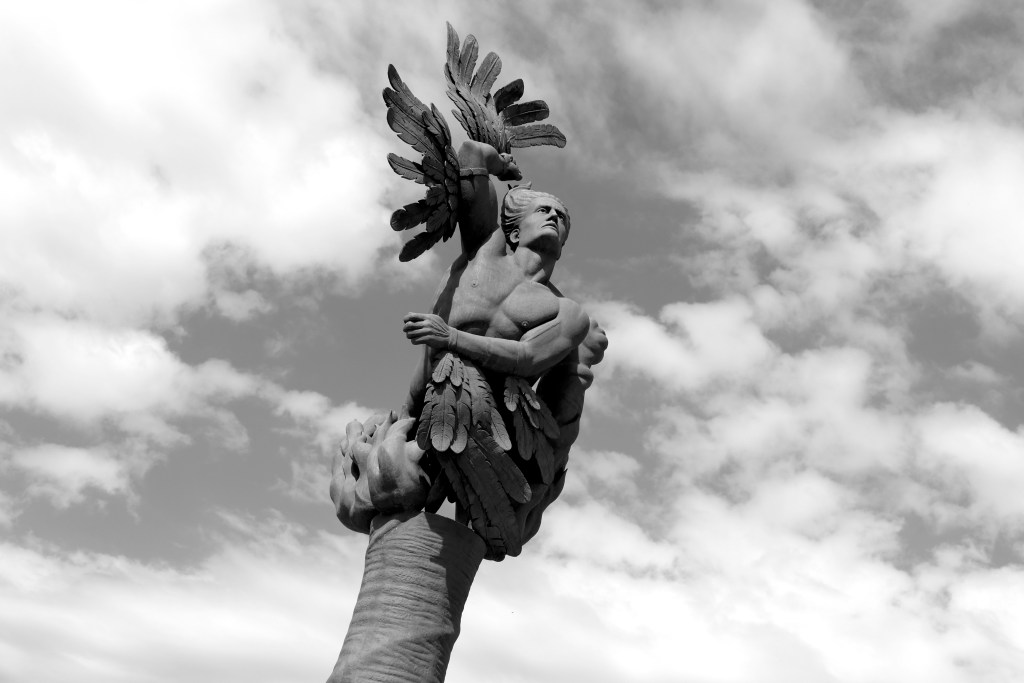
A reference to Icarus, who flew too close to the sun.
What about them?
When the junta came to power, it was Canada’s Centennial Year. Amidst the celebration, we received news that my uncle Panayioti had been rounded up in the dead of night (they always make sure it’s the dead of night), and shipped off to a prison island. How did they know to round him up, and not the next-door neighbour? Every town kept a list of undesirables. Men who joined the wrong party, fought in the wrong resistance group, played tavli with the wrong friends. German collaborators didn’t make that list, so they slept soundly. The CIA’s fingerprints are all over this period of Greek history.
You have plenty of time on your hands while you’re in jail, time that my uncle used to learn the plumbing trade, carve knick-knacks and improve his chess. When he was eventually released, after the junta fell, he set up a plumbing business and did pretty well at it. I remember a small balsawood plaque on the wall, of a mermaid carved in low relief.
As for his chess, I tried playing with him on one of my visits and, as expected, he was merciless. He loved me because I was his brother’s son, but he was a difficult man: an uncompromising, argumentative fanatic. When I think of him, “wild-eyed” comes to mind. To this day, I wonder if the crazy was a pre-existing condition. In other words, whether the crazy helped him survive the abuse, or whether the abuse caused the crazy.
I remember a conversation at a kafenio: “But what about all the people that don’t side with the revolution?” I asked. “What about them?”
“Off with their heads,” he said, chopping the air with his hand. He saw the look on my face: “And what would you suggest?” he continued. “Side with a few factory owners instead of the hungry millions? The sooner we’re rid of that bunch, the sooner we’ll have a just world.”
I thought of my mother, who worked at a factory making ladies’ blouses. She had been offered the job of “forelady” but turned it down because she could make more money doing piecework. She was fast, and proud of it. Loved her Electrolux vacuum cleaner. What about her?
None of this matters any more, of course. The factories where my mother worked vanished long ago. As for the owners and their descendants, I’m sure they’re doing fine. They’ve just moved on to other things.
I saw Mikis Theodorakis once, in Montreal, when he was on tour with a small orchestra. Around the same time, there was also a bootleg 45 rpm record floating around that Theodorakis made while in hiding: just him and a microphone in some random room, singing a protest song under his breath and keeping time by knocking on a table. It was haunting to hear. Not music, exactly, more like an artifact, maybe a warning.
When he was in the Resistance, one of Theodorakis’s duties was to protect Jews against capture. Then, late in life, he became an extreme nationalist — a soured old man ranting about a global Jewish conspiracy. Nothing new there. In his final act on stage, Mikis Theodorakis disgraced himself.
One final glance back
In Chania, we’re eating the best oranges of our lives — winter oranges, if you please. Between oranges we study Cretans and their cats, because cats are everywhere you look. Kind-hearted Chaniotes leave out saucers of food and bowls of water, and yet the cats won’t be satisfied. They lurk under tables, rub against legs and stare from beneath cars, by turns suspicious and beseeching, with their me-so-hungry little cries.
Then, driving to Agia Triada monastery. A man at the gate shuts his money box and waves us inside the instant I address him in Greek. Into a sunny courtyard we emerge, where Greek and ecclesiastical flags snap in the wind, and a monk wears Crocs beneath his robes, and the solemn icons in the exquisitely small museum display a black-skinned devil with a slithering red tongue forever teasing the doleful saint’s ear, and the brilliantly coloured bishop’s vestments in another display, and the silver buckles and belts and other precious doodads that make the bishop such a grand old fellow.
Then back to Chania and to our inadequate kitchen, where I make the classic Greek stew of artichoke hearts and fava beans, fragrant with lemon and dill. It takes a podcast-and-a-half just to clean the artichokes and shell the beans, but when I’m done — my God, it’s good!
To our favourite restaurant, then, where we order the fava and octopus on two occasions because once is not enough (not that twice is enough either). Where we can watch the ladies bustling in the kitchen from our high table. Where a waiter is taking a break and making a quick sign of the cross before wolfing down a plate of unsauced spaghetti. And, wait, did I mention the other two ladies, taverna proprietors both, presenting their homemade bergamot jam on yoghourt to finish our meal, and the bergamot tasting like a strong dose of Earl Grey tea, and did I mention the wild greens drenched in olive oil, and the tiny salt-cured olives, each no bigger than a raisin, and how small bags of these olives found their way into our suitcases?
Then home…
With our luggage safely tucked into the plane’s belly, I finished reading The Flaw, closed the book and sat for a long time staring straight ahead, a little stunned by what I had just read.
There was nothing to look at, so my eyes settled on a fellow passenger across the aisle, sitting one row ahead. A giant bag of Lay’s potato chips, Greek edition and therefore sprinkled with oregano, sat open on his lap. He was eating each chip slowly, like a cat eats, with infinite care. A flight attendant spotted him and came running over to tell him those “exact same” chips are her favourites. To prove it, she opened a shopping bag to reveal several bags of the “exact same” chips. She buys them whenever she works the Athens flight. They giggled together.
I thought they were both out of their minds.
We belong to a book club that’s been meeting for more than thirty years. We like to call it a book club, but we always fuss over and talk about food more than about the book. Maybe I’ll propose The Flaw the next time we host. It would surprise the members, as we’ve never read a book together by a Greek author. It lacks food content, but so what?
* * *
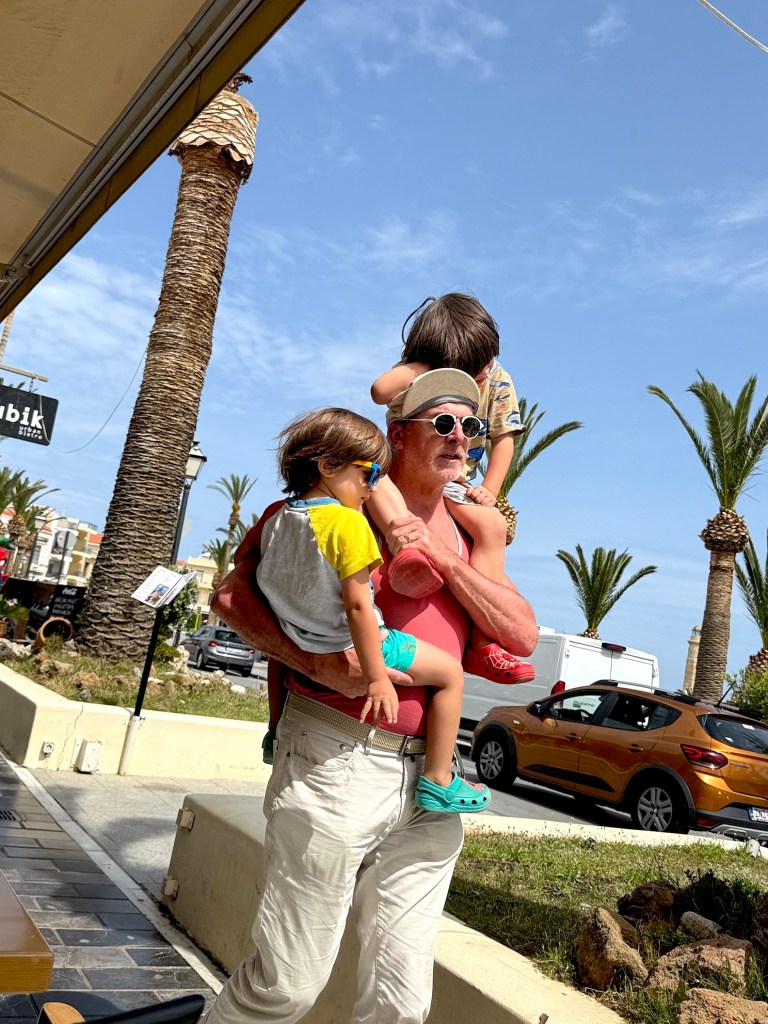
By the way, if you’re interested in seeing a few more photos from our trip to Crete, have a look at the Just Taken section in my new photo site.
 because i said
Great read as usual, great pics too!! Let me know when we do an easy jog! 🙂
LikeLike
It would be a pleasure to do an easy jog! Except that I hurt my back before we left Crete (for whatever mysterious reason) and haven’t run for over a week. I’ll go out tomorrow just to try it out, for 3k or so. We’ll get it done this summer for sure! Thanks for reading and for messaging!
LikeLike
Loved reading this, Spyro:) And your photography!!!!! It’s always wonderful! See you soon! Lori
>
LikeLike
Thank you, Lori. I appreciate your taking the time. See you soon. Actually, real soon!
LikeLike
just flew back from Spain yesterday! Another Camino under my belt – the Invierno. Off to see the orthopod soon. My knee betrayed me. I love(ed) Theodorakis…. It was wonderful to watch him conduct. Nice pics
LikeLike
Another Camino? That’s very impressive. Glad you know Theodorakis. Thanks for reading, thanks for commenting.
LikeLike
I bet that three weeks went pretty fast. Very fun good read!
Mary
LikeLike
Actually, three weeks went by not so fast. Had time to luxuriate in the experience. Thank you for reading. Hope to see you when we return from our next trip.
LikeLike
Wonderful – one of your biggest cast of characters yet – human, feline, combative, driven, incarcerated, misguided in their eating habits, all interesting. Makes me wonder what you could produce with the benefit of a little jail time. Can’t wait to read The Flaw. Gerry.
LikeLike
Thanks for all that, Gerry. Much appreciated. I hope you get to read The Flaw also. I’ll lend you my copy (apparently it’s not easy to get). We’ll discuss when I get out of the slammer.
LikeLike
This episode offered me a place of repose. Thanks. And the new Just Taken section makes me smile.
LikeLike
The above Anonymous, again, is Jane. Can’t figure out how to add my name. Argh.
LikeLike
Thank you, Jane. A place of repose is always good, although I don’t know what, specifically, did that for you. And thanks for looking at my photos. I do hope all is well at home (you and Sami are in our conversation often) and that we will get to see you sometime this summer.
LikeLike
You magically weave history, politics, family, tastes and facts I suspect are never in tourist guides.
Oh yeah, and always with your sharp eye and wit!
Grazie.
LikeLike
Thanks, muffin. I miss you. And thank for the Italian word. It means so much.
LikeLike