I just finished reading The Shortest History of Greece, which is 242 pages in length. My favourite paragraph is about the hard-fought 1920 national election:
“To general amazement, the [monarchist] opposition won. Perhaps it was resentment at the continuing violation of Greek sovereignty by the Great Powers. Perhaps it was the sudden death of King Alexander from a monkey-bite and return of his popular father, Constantine.”
Excuse me, monkey bite? A little context, please? Such as, what was the monkey’s name? What exactly did King Alexander do to provoke the monkey? And, was the monkey wearing a fez?
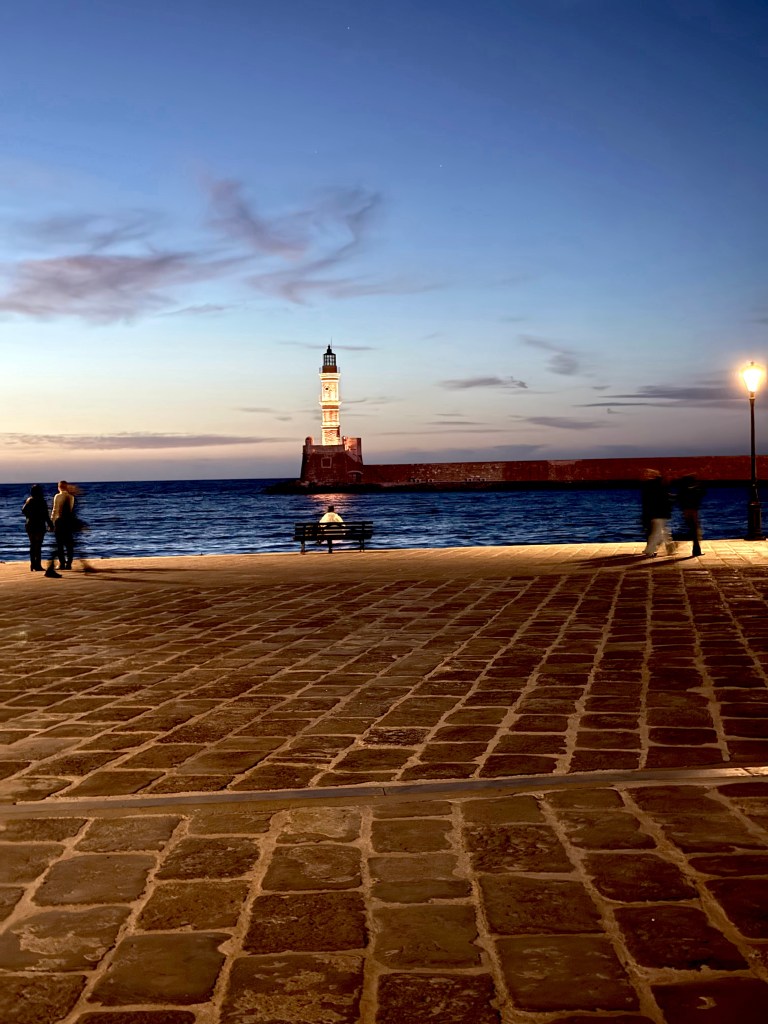
These and so many other questions trouble me as I walk east on Koum Kapi beach, which is a five-minute walk from our front door and is not really much of a beach at all. There’s an abbreviated bathing area, but most of Koum Kapi is lined with cafes and restaurants spilling onto the paved promenade. And, unlike the colourful and crowded and over-photographed Venetian harbour a ten-minute walk west of here, it’s mostly locals who sit at Koum Kapi and talk at all hours at the highest possible volume. I like it here a lot.
As I say, I’m walking east today, instead of at usual running pace, because when you slow down enough to study things, you see and learn so much more.
For example, at a bend in the road an elderly man is removing a plastic jug from the back of his car to water some flowerpots. Beside him, his wife is sweeping the road. As I pass them I see that they’re tending a tiny whitewashed shrine, the size of a breadbox. Inside, there’s a black and white photo of a handsome palikari, the small flame of a kadili animating his dark features.
I don’t greet them, as I don’t know what to say. But when I glance back, their somber faces break into a smile. The man touches his hat.
Luxe boutique hotels
Beyond this scene, immaculate stone buildings face the sea. This neighbourhood of swish hotels was once Chania’s tannery row (Crete is famous for its leather goods). But there’s only one functioning tannery left in this neighbourhood, as far as I can tell. The rest of these buildings — hundreds of years old, mostly dating from Ottoman times — have been gutted, sand-blasted and sealed up with tinted windows. You cup your hands to peer inside. A soaring lobby, where rusting machinery sits on granite bases. You can’t get more la-di-da than that.
Greece seems to be rebounding, at least on the surface, from the mass exodus and rash of suicides that accompanied the debt crisis. I’m made just a little hopeful by jokes still in circulation:
Angela Merkel shows up at Athens Airport.
‘Nationality?’ asks the immigration officer.
‘German,’ she says.
‘Occupation?’
‘No, just here for a few days.’
* * *
We’re driving high in the mountains, looking for Lake Kournas, which has the distinction of being Crete’s one and only lake.
We pull over for the view, and from a distant farmhouse far below, the sound of barking dogs. Closer still, intermittent bleating and the tuneless clunk-clunk of sheep bells. And, on the sloping sides of the mountain, massive olive trees in every direction, tightly gripping the stony earth. After the spring and winter rains, the trees are dark, impenetrable, heavy-hipped. And beneath these Cretan matrons, a waving riot of waist-high daisies, poppies and flowering herbs.
This is a different Greece. Different from the dreaming, depleted Greece of summer. This green and youthful Greece is bursting with colour, life and promise.
* * *
Still mulling over the monkey-bite affair, I come across a handsome stone house facing the sea. Every door and window is sealed shut with plywood, and the place seems abandoned. On its patio, which has the same million-dollar view as the nearby boutique hotels, a couple of pup tents are pitched in the shade. A blanket and a stained sleeping bag hang from a clothesline.
I’ve passed this place several times now, and the cast of characters is always changing. Today there’s a young woman with a child, a bored-looking adolescent boy, and a middle-aged man burnt brown as a chestnut. You can never tell if they’re related in any way, and they’re all sitting and staring at the sea, as if waiting for someone.
Across Greece you’ll find many properties like it, lost in legal limbo. It might be because of untimely deaths, non-existent or unclear wills, or the glacial pace of Greek bureaucracy. Or, another more consequential reason: long-simmering feuds between those who stayed and those who left. Feuds inflamed by distance, silence, bitter grievance.
My own family was no exception, on both sides. To this day, there are untended olive and orange trees going to ruin. Modest houses, idle plots of land, all of them languishing.
In late middle age, my father was consumed by all this. (I’ve written about it before, but every time I look at these events, they’re different.) He spent most summers in Greece, and every trip offered another chance to straighten things out, divide the property, have done with it.
Every summer, he’d consult yet another lawyer — a friend of a friend, the niece of a friend, someone from the classifieds promising “quick results.” Always, he was just one lawyer away from having it all settled, from fixing his legacy for all time.
Back in Montreal, he paced the living room and fumed all winter long. He was eager to infect me with his bitterness, but I stayed out of it. Then again, I’ve never had enough interest in money and property. Which, I guess, does not make me a good enough son — or a good enough historian of these events.

* * *
In The Shortest History of Greece, thousands of years of civilization, already picked over by thousands of historians, are smooshed into less than 250 pages. The book is like a McDonald’s Happy Meal. But I’m still hungry. I have therefore solemnly pledged to improve my Greek by reading more books in the language of my father. Maybe I’ll take a year off to study the Peloponnesian Wars. You know — learn a few things for a change
But don’t bet on it. I’m weak and always making excuses. And besides, if I’ve learned anything about ancient Greek civilization, it’s that the proper study of history (man and his works, as we used to say) begins with understanding the tangled mind and heart of man. Understand those great things, and every minor thing snaps into focus — such as a small and pissed-off monkey in a fez, about to change the course of history.
 because i said
Thank you Spyros. Captivating reflections. So glad you were able to avoid the bitterness and find interest/meaning from the past…brillant…
LikeLike
Thank you.
LikeLike
Excellent, lots to chew on here. And images and sounds to imagine.
The photo of the harbour is terrific.
Alison
LikeLike
Thank you, Alison. I’ll be posting a few more photos at some point. Hi to Denis!
LikeLike
Nice stories, Spyro! I really enjoyed reading this and all your insight:) Lori
>
LikeLike
Thank you, Lori! Always good to hear from friends.
LikeLike
This is a nice read. I am from the States and love traveling to Chania and Crete. I enjoyed your reflections of this area.
LikeLike
Thank you. I am from Canada and haven’t been here in a long time. Hope to be back, though.
LikeLiked by 1 person
Thank you for such an entertaining and thoughtful read – from beaches to mountains, monkeys to Merkel, and tended shrines to kept grievances.
LikeLike
Thank you for reading and taking the time to comment. I do have a tendency to flit around, and I’m glad you noticed.
LikeLike
Loved this! From monkey-induced royal chaos to lakeside serenity and existential roadside shrines!. When you’re back, let’s go for a run and unpack all of it (though I make no promises about avoiding monkey jokes mid-jog).
LikeLike
Thank you, Julio. Always great to hear from you. Would love jog (not run) with you. I am, sadly, not much of a runner any more. But the spirit is willing, and monkey jokes are always welcome.
LikeLike
A Barbary macaque that belonged to a resident of the palace attacked his dog. When the king stepped in to separate the animals, he suffered several monkey bites that would soon get infected and turn septic. Some three weeks later, the king was dead, having served only a brief few years on the throne… Could not help myself 😂
LikeLike
Of course you can’t help yourself! But you know we’re living in a post-fact, post-truth world. If I wanted to check Wikipedia, I would of course do it. But it’s probably the work of AI, just like everything else. (Just kidding.) Glad to hear from you. We have an election coming, as you may know, this Monday, and Shari and I mailed in our ballots before leaving home because we want to defend Canada precisely against a post-fact, post-truth world.
LikeLiked by 1 person
I did learn something though, maybe the king wasn’t that popular as his father but he did love his dog which is nice. Indeed curious about the outcome of elections, in the Netherlands we made a mess out of it and I don’t wish that for you, happy Kingsday (our nat’l holiday is today)!
LikeLike
It’s suspect that the history of a nation could be crammed in to such a slim volume when just your accounts of loud talking locals and loaded backward glances reveal so much here. You’ll be used to the volume level when you return for the Habs playoff run. Thanks for writing. Gerry.
LikeLike
Looking forward to the playoffs, assuming the Habs are still in it when we return. Second thing I’m doing, when I return, is buying a monkey. Will have all its shots, though.
LikeLike
There is a wet market in St Clet. I know someone. G. (I’m staying “anonymous” for this one.
LikeLike