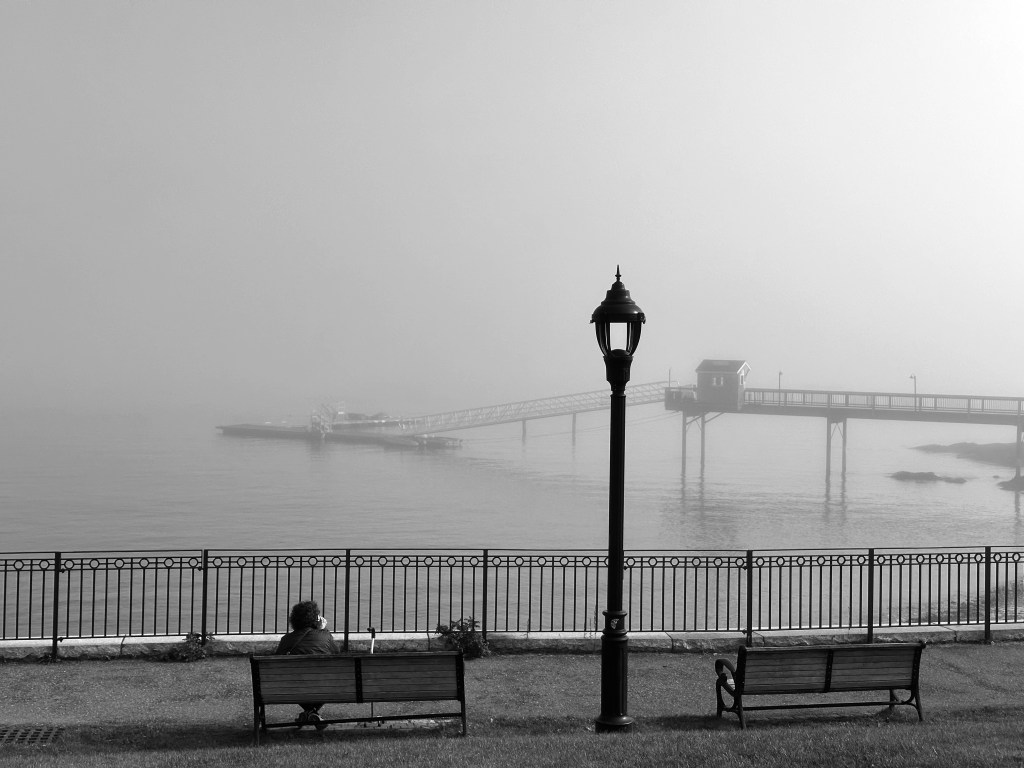
From my high vantage, I have a bird’s-eye view of the town of Bar Harbor, Maine and of the ugly cruise ship parked half a mile out and waiting for its humans, who are now scattered up and down Main Street buying oven mitts and bacon jam.
I have a bird’s eye view of this affair because I’ve been running on the celebrated carriage roads of Mount Desert Island, which rise and fall gently along the nearby slopes. We arrived during peak-autumn, when the leaves are still holding tight, the sun is benevolent, and the forests blaze with colour.
John D. Rockefeller built the carriage roads — forty-five miles of them. Wide, handsomely engineered thoroughfares winding through forests and offering to John D.’s moneyed neighbours — the Vanderbilts, the Astors, the Pulitzers and other millionaires (in today’s terms, billionaires) who vacationed here — sudden vistas and veiled forested views. They all had motor cars by then. But taking a horse and carriage to dine at a friend’s is so much more country — don’t you agree? — than ordering up the Rolls.
King of soup
A five-minute walk from where we’re staying takes you to La Rochelle, a 41-room brick chateau. It is in spic and span condition and was built in 1902 by George Sullivan Bowdoin, a rich banker descended from a Huguenot family that…
But this is already too boring. Far more interesting is that La Rochelle soon fell into the hands of John Thompson Dorrance, the MIT-trained chemist who invented condensed soup. He later became president of Campbell’s Soup, and his grandson donated La Rochelle to the Maine Seacoast Mission. It’s now the Museum Mansion and Historic Center.
Upon learning that I am Canadian, the lady who took my money and welcomed me to the museum told me that her grandfather had emigrated from Newfoundland. She visited once, the lady remarked, gazing off wistfully, “to see where my people came from.” When I asked if she had enjoyed her visit, she became oddly evasive.
Roots
The day after we arrived, I went to the local Hannaford’s supermarket to shop for Thanksgiving dinner. I admit, we were a little homesick. We have now spent two consecutive Thanksgivings at Bar Harbor, each time scouring the region for turkey parts.
It was early morning and Hannaford’s was almost empty except for me and two guys standing at checkout. One was young, skinny and dreadlocked, in a black tracksuit, green socks and blue plastic sandals. The other was bearded and heavyset, also in a tracksuit. Packs of industrial chicken, onions, peppers and half a dozen cans of Campbell’s soup littered the counter. But what caught my eye was a large black root. The cashier put the root on the scale.
“Twenty dollars, sir. Still want it?”
Young-and-skinny sucked his teeth. He picked up the root and, in no great hurry, sauntered over to the produce section and came back with a smaller one. Bearded-and-heavyset flashed the cashier a dazzling smile, hoping to take the edge off his friend’s rudeness.
She weighed it. “Twelve dollars, sir,” fingers once again poised over the register. A faint, grudging nod, she punched it in.
Homesick, I thought, watching them go. Cooking up a pot of something hot, something their mothers make back home. Something to ease the ache and the cold.
Back at Hannaford’s a few days later, curiosity led me to the produce section. I picked up one of the roots and examined its tiny label: Yellow Yame. Product of Jamaica.
I’ve learned that, if not for Jamaicans, the hospitality business in Bar Harbor would collapse. They arrive as the tourist season opens, leave when it closes. They make beds, cut grass, mop floors, wait tables, stand and smile behind counters. In Ellsworth, a forty-five-minute drive from here, a small community of Jamaicans have put down roots, bought cars and homes. Walk around and you see miniature Jamaican flags, knitted from green, black and yellow yarn, hanging from rear-view mirrors.

A death in the family
In fact, I’ve been thinking a lot about homesickness, because a month ago a close friend lost his beloved mother. I remember a wise, beautiful and strong woman who met every kindness with generosity and love. If memory serves, she had also been a shop steward at the factory where she worked. So, also a leader and an organizer. With a penetrating gaze that reached right into your heart. In plain language, you would not want to bullshit the lady.
It hits you all at once, doesn’t it? Home, that designated refuge in the mind which always remained a possibility, is suddenly revealed as an illusion. Objectively speaking, you always knew this. You knew that the years cannot be unwound, so you’d better make the best of it. And yet, hanging from your rear-view mirror, a small knitted flag…
* * *
Years ago, when our Greek mothers were healthy and indomitable, I would visit this friend and we’d sit in his basement for hours. A snifter of Drambuie, a cigarette, Willie Nelson’s Stardust on the hi-fi. We compared notes about our immigrant mothers, about how disagreements often flared up in oddly identical ways, with exactly the same words:
“Excuse me for expressing myself,” I would begin, in our mother tongue. “I am only the woman who carried you for nine months. So of course my ideas are worthless, no longer in fashion.”
My friend would take over: “Alas, times have changed and your poor unschooled mother has not changed with them. But then, we are not educated and worldly like you. Young people today are so modern so progressive…”
“Whereas we, broken-down relics, could never keep up with your advanced ideas, so much more interesting than our outdated…”
And so on, all in Greek. Heaping dollops of sarcasm and mockery, delivered in the stilted language of wounded pride. We might go on for hours, snifters declining, ashtray filling up, hi-fi silenced.
What we never imagined, when we were younger and stupid, was the depths of our mothers’ own homesickness. What they had gained, but also what they had lost: the place they could never return to.
* * *
Just past La Rochelle you’ll find the mansion where Mary Roberts Rinehart summered. I had never heard of Rinehart, but in her day she was “the American Agatha Christie.” Sixty books, hundreds of stories, plays and articles. Her mysteries sold millions. Among them was the first one in which the butler actually did it. This was prophetic, because one fine day, her Filipino chef, who had been with her for twenty-five years, picked up a gun and tried to kill her. Except, his gun misfired. He tried again, again it misfired. So he fetched his carving knife. But then the chauffeur burst in and disarmed the murderous cook. He was hauled off to jail, then hanged himself the next day.
Campbell’s soup, attempted murder, bacon jam. You can’t make this shit up.



Hey Spyro,
Thanks for another astute travelogue and moving account (of our immigrant mothers).
All our parents dreamed of the day they’d move back to the old country, few made it. Even I longed to go back only to be quite disappointed while on a visit. It is not only a question of geography but one of time of course, forever changing and morphing one’s memories into unwanted realities.
Always a joy to read you my friend.
K
•••Karimobile
514 9944433
LikeLike
Thanks, Karim. Maybe no one ever made it back home. As you astutely point out, it’s not a question of geography. That place only exists in the mind, but believing in it helps you to keep on going, sometimes. Anyway…complicated. Always a joy to hear from you.
LikeLike
Congrats, Spyro, on another thought-provoking essay!
Your photo, in particular, of the moored rowboat is a vey subtle
but powerful metaphor;
“We are like oarsmen, moving forward but always looking back.”.
Mike
LikeLike
Thanks, Mike. I appreciate that you’re reading and looking so carefully. I like your quote, too. I googled it but got nothing. Did you coin that?
LikeLike
Unfortunately, Spyro, I can’t take credit for the quote,
but I think it’s a line from poetry. If I find the source I’ll
let you know.
Mike
LikeLike
Beautifully expressed Spyro. Your observations of encounters with other travelers and especially the locals you meet along the way are funny and sad at the same time. Every person has a history and a story – the Jamaican man at the grocery store, with his expensive root vegetable, that he’s probably homesick, living and working in a remote area predominantly run by white privileged Americans – so foreign to him and far removed from his homeland… you capture the essence of what migrants and refugees live through on a daily basis – doing whatever is necessary to simply survive. It’s the reality of our world today.
The reminiscences of your past and anecdotes of moments that you had with family, are so familiar to me , and bring a tear to my eye, remembering similar moments and conversations with my parents, long gone now – but there are many cherished memories. Thank you, Spyro.
LikeLike
Thank you so much, and I wish I had info on your identity, so I could reply more properly. Regrettably, this thing I work on is getting creakier all the time. But, again, thank you.
LikeLike
My apologies dear Spyro😏- your unidentified commenter today is none other than Lara… love your work.
Lara 😘
LikeLike
Thank you, Lara. I didn’t want to put you on the spot, but you were so generous with you comments, taking the time to comment at length, that I couldn’t possibly just say thanks. Again, thanks for your generosity. Of course, the current attitude toward immigrants, here and around the world, is demoralizing. I hope to hear about your travels soon, and I’m glad you finally made it happen. I’m sure you’ll have much to say. Soon!
LikeLike
Spyro so evocative as always…heartbreaking, funny, wistful..are these ALL the heartstrings?!
Mary
LikeLike
Thanks, Mary. So good to know someone is reading. According to you, I have almost as many strings as a ukulele, but I was shooting for a guitar. Maybe next time.
LikeLike
Dearest Spyro,
Every time I receive one of your blogs, I place it in the “ because I said so “ file intending that one day, when life imposes less on my time, to read all your travels, thoughts and experiences, like a book. Wait…. that’s an idea, if David Sedaris can do it……..
I was prompted to read this particular one. You have offered us a “knitted” story, spun from a handful of ordinary words, making us sense the longing immigrants experience. The loss our mothers (fathers) experienced. Nostalgic for one’s home, from the Greek word nostos reflective of Odysseus sea voyage from Troy to his homeland of Ithica.
Could the sense of longing or loss, by the Filipino chef, possibly have contributed to the attempted murder of his boss??
Thank you Spyro for referencing our mothers.
Bless you,
Olga
LikeLike
Thank you, Olga, for your lavish praise and for reading so carefully. I wouldn’t expect anything else from you. Everything you say is spot on. I include details that do knit together, as you say, but also details that almost fit, leaving the reader to wonder.
I had hoped that your brother would read this, since he figures in this post so prominently, but alas his email is down. I’m sure he’ll catch up with it when his IT issues are resolved.
LikeLike
Wonderful “weave” Spyro. Given my own family history and travel habits one might think that I would understand what it is to be homesick, but it is not something I experience. What “hits me all at once”, far more often than I would think is healthy, is the loss of youth. Reminders of lost times and vigour are usually tied to a place, and that place most often is home. In that sense it is more nostalgia than something I miss. I’ll need to think this all through – maybe before I leave my current vacation spot. Thanks for your reflections. You have a way of making your readers look inwards. Gerry Vanderbilt.
LikeLike
Thanks, Gerry. In fact, what you say is what I’m getting at. The loss of a geographic “home,” but also the loss of a time when you felt most at home — but probably didn’t realize it at the time because we’re all so stupid when we’re young. We can never return to either. It’s the impossible dream of a return. This dream can also be toxic, as we’re witnessing in today’s politics. Thanks for reading and commenting so thoughtfully from your safe space somewhere down there.
LikeLike
Please, please keep writing!
z.
LikeLike
Marvellous piece of writing which obviously touched many people.
The two b/w photos are terrific.
Alison
LikeLike
Thank you, Alison. Glad you’re back.
LikeLike