
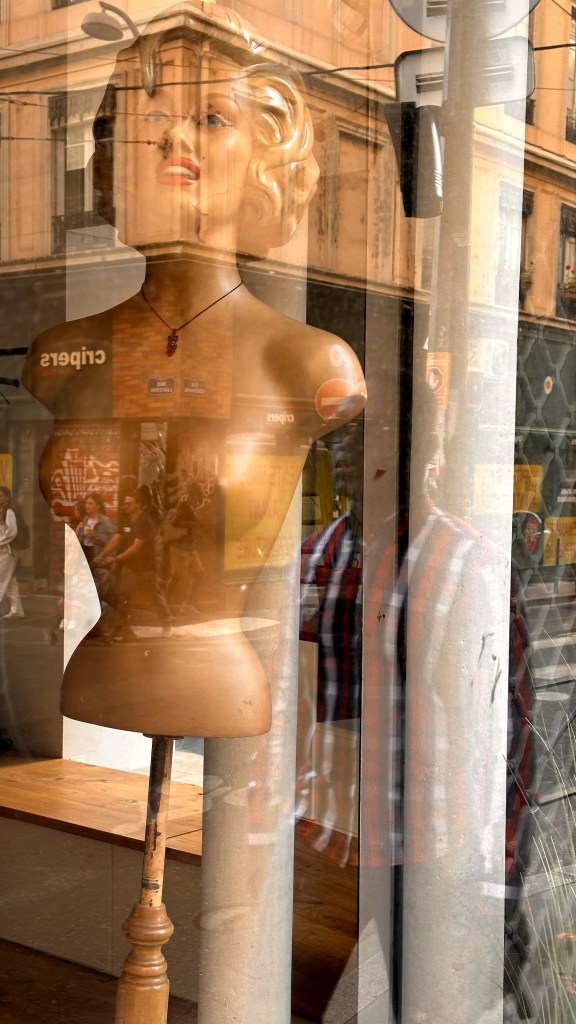
We are in Lyon, the food capital of France, eating with chopsticks. We ate at an Asian restaurant last night as well, and will ask for chopsticks again tomorrow, at a place where the steamed buns and barbecue pork belly, with a side of kimchi, are especially good.
While in Lyon we stayed on rue Franklin, in the 2nd arrondissement, and were greeted on arrival by a charming lady in a summery black top, flowing skirt and flipflops. She at once informed us that our rental, a bright, high-ceilinged and elegant space, is her former living room. We felt bad. How do you live without a living room? She also informed us that our room comes with a daily baguette, which we can fetch every morning from the bakery downstairs. This can only happen in France.
The Pope of gastronomy
The Lyonnais worship food and lionize those who make it. The great Paul Bocuse was a native son and a god. So it’s no surprise that, propped up on a high shelf in our rental apartment sits an oversize menu from Bocuse, the great man’s flagship restaurant. He is on the cover, in chef’s whites, chin propped on one hand, smiling down on us from his high shelf.
Inside, on the left-hand page, is a six-course table d’hôte. It starts with Lobster in Iced Pouilly-Fuissé Court-Bouillon with Lemongrass and Caviar. Next is Truffle Soup V.G.E. (“a dish created for the French president in 1975”), followed by Filet of Sole in Citrus Fruits Viennoise. The lucky diner, white napkin tucked into collar and gripping knife and fork, is then served Bresse Chicken Truffled and Cooked in a Bladder à la Mére Fillioux. If it hasn’t occurred already, a selection of local cheeses and a choice of desserts will finally cause the diner to burst.
The menu is dated summer of 2019, just before COVID, when the table d’hôte was 280 euros per person (not including wine).
You can of course order à la carte from the facing page, where the above dishes and others are listed together. In that case, the whole Bresse chicken, truffled, will set you back 260 euros, but if you’re on a budget you can opt for Whole Spit-Roasted Pigeon “as Monsieur Paul liked.” That will be 80 euros, monsieur. A plate of Truffle Soup V.G.E — you know, the soup created for Valéry Giscard d’Estaing — is 90 euros, so this gives you an idea.


Our location on rue Franklin couldn’t have been better, as we were flanked by Lyon’s two historic rivers, the Rhône and the Saône, each just a few minutes walk from our front door. On our second day we headed for the Saône, where I elected to run to the confluence, which lies south, or to the left. After flowing for hundreds of kilometres apart, this is where the two rivers finally merge and flow onward as one body of water (the Rhône), and finally empty into the Mediterranean.
To the confluence and back, with a few minor detours, I managed 10 kilometres. Along the way I saw a scattering of tents, where some of Lyon’s homeless live — although I’m not sure if living in a tent qualifies as homeless. Probably not, and I apologize.
And in fact I saw decorative signs of permanence. A bouquet of plastic flowers stuck into the ground, a spray-painted upside-down bike, small flags fluttering in the breeze. In the shadowed interiors I glimpsed bedding, books, toiletries. No one home. Maybe they were out scrounging their next meal. In the food capital of France, where the great Bocuse is God, did these tent dwellers experience food insecurity?
I can’t say I like that term, “food insecurity.” I’m sure the experts invented it for very good reasons. It is clinical, likely has a definition hammered out at large conferences, conveys no emotion or judgment. Except, hungry actually feels like something and starving feels like something worse.
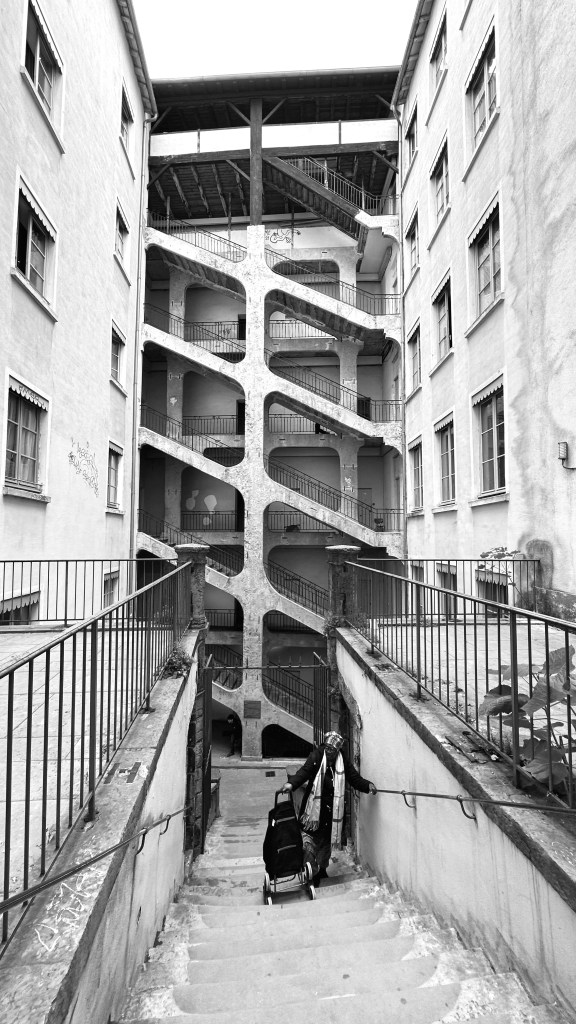
Dying of hunger
My mother often spoke of the war years, when hunger stalked the land. She remembered going to the village agora with her family to meet the trucks arriving from Athens. In the great capital, the Occupation was exceptionally cruel. Five percent of the Greek population would eventually starve to death, and most of those dead lived in cities. There are photographs of ordinary Athenians walking past piles of corpses on the street. They don’t turn their heads, for what else is there to see? Starvation killed more Greeks than bombings, reprisals, executions and battles with the Resistance ever would.
Some of Athens’s children were loaded onto trucks and taken to distant villages, where conditions were less lethal. Villagers could always forage for wild greens and prickly pear, set traps for migrating birds. They might have a garden, olive trees, figs. A few handfuls of beans could feed a family, even with an additional mouth from Athens. By meal’s end, everyone might still be hungry, but no one would starve.
Meanwhile the Occupiers blew up bridges, ships, roads and factories. Agricultural production ground to a halt, and most of what was left went to the Occupiers. If the Occupiers met resistance, they machine gunned farm animals, set fire to villages, massacred everyone on sight. Starvation was not a by-product of war, it was a strategic weapon of war, meant to destroy the spirit. During the war, only the occupied Dutch experienced a comparable level of food insecurity.
* * *
A young girl, maybe fifteen, watches children being handed down from a truck in the agora. Are the kids crying or too tired to cry? Do they seem frightened? What are they wearing? She never said and now it’s too late to ask. Mostly, she remembered swollen bellies, stick-thin limbs. She remembered their silence.
And another curious thing: she remembered bristles sprouting from the children’s faces. I’ve tried to look it up. Does starvation cause this? I’ve come up with nothing. But this one detail, the whiskered starving children — Afroditi would always insist on that.
Many years later, in her middle age, Afroditi would clap her hands with delight when any child entered her little grocery store. Grabbing a handful of candies or chocolates, she’d kneel in front of each child and fill its pockets. Never fruit, just candies and chocolates. Today’s parents would disapprove, and I wonder if they would understand.

 because i said
incredibly powerful Spyro, very moving. I am quite choked up reading that part. Of course, everything led up to that.
the photos are terrific. Love the shop window reflection. Lots going on there and many layers of innuendo (does that make sense?). Kimchi in Lyon, who knew?
Bravo! I am always excited to find “because I said” in my inbox. You never disappoint. xox
LikeLike
It’s me, Alison, masquerading as Anonymous, though not intentionally.
LikeLike
Thank you, Someone (Alison). Glad you felt something, good, bad and in-between. Hope you’re OK during the heat.
LikeLike
Always enjoy your musings Spyro. This one specially so (intentional?) given the ICC’s recent pronouncement that the intentional starving of civilians by “depriving them of objects indispensable to their survival” constitutes a war crime.In WWll, my mother-in-law ate tulip bulbs in Amsterdam and my father-in-law and his brothers avoided starvation by being sent to a farm. History repeats…
LikeLike
Thank you, Lenore. The timing with the ICC thing was not intentional on my part, but starving people with a view to breaking them is hardly new. I was discussing this very thing a couple of evenings ago with a woman who was born in Holland. Similar stories: eating tulip bulbs, etc. So, yes, a lot of commonalities. See you soon and happy you took the time to comment.
LikeLike
Lenore here posting under the cover of anonymity
LikeLike
This is marvellous and so are the photos. Using Lyon as a jumping off point for so poignant an interlude and ending makes one anxious to hear more of both Lyon now and Athens in the War. Keep writing. John Aylen
LikeLike
Thank you, John.
LikeLike
Few see and fewer still report on the less glamorous elements of travel destinations and history. You do so masterfully here. If you ever make it to Capetown you might break if you take on these themes. Remember to pit your napkin across your lap.
Gerry
LikeLike
Not sure I could endure the complexities of South Africa, as you have. And once again, my table manners betray my low origins.
LikeLike
Thanks for this Spyro!
Always so entertaining and such great photos!
xx
K
•••Karimobile
514 9944433
LikeLike
Thank you! I hope you’re well away from the heat. Worse there than here, I’m afraid.
LikeLike
I loved reading this. My mother told me about how her mother could cook meals for five children utilizing all kinds of what we might consider “lesser cuts of meat” and make everything taste delicious. Of course she made her own noodles. She also knew how to set the table so it looked like a festive meal. Thanks for sharing your gastronomic experience in the context of family history. I especially loved the part of your mother giving candy to the children. I just got home from Scotland and have quite the case of Covid. My son has stocked my kitchen with lots of incredibly thoughtful treats such as freshly squeezed tangerine juice! I was boosted before I left for the trip but alas it still found me. I guess the good news is that it waited until I was headed home. Best to you and Shari ~Hillary
LikeLike
Thanks for reading and commenting, Hillary. We forget how good we have it, because of the sacrifices of people before us. Bottomless stupidity of humankind, I guess. The good news is not only that Covid waited for a more convenient time, but also that your son spoils you. All the best!
LikeLike
Spyro,
I enjoy your writing so much! You’re a wonderful photographer and storyteller of things present and past. I’m intrigued with what your mother called children’s whiskers.
Hugs to you and Shari💕
Brenda Swenson http://www.SwensonsArt.net
LikeLike
Thanks for reading and for your praise, Brenda. Hugs right back at you!
LikeLike
Dear Spyro,
I just loved your latest post. As usual there is so much wit and truth to what you were saying . You could have been talking about any city, Strasbourg, Paris, Marseille…
I tried to leave a comment but somehow it’s not working ??
Hope you’re enjoying your week.
Lots of love.
Best, Ilana
>
LikeLike
Well what do you mean, you “tried to leave a comment”? Your try worked and your comment came through! Thanks for reading and for commenting and enjoying (although enjoying may be the wrong word) my words. I do hope you’re feeling better and look forward to seeing you later this year, when you visit. It’s really not that long from now. Again thank you, get well and much love.
LikeLike
Oh great, it worked ! Have a good night.
Speak soon.
>
LikeLike