As I write this, I am sitting at a small plastic table outside our room at Shea’s Riverside Inn and Motel in Essex, Massachusetts.
Our room, the Fredonia (#14), is flanked by the Caviare (#12) and the Eugenia J. (#15). Eugenia is the belle of the motel, as she offers a panoramic view of the Essex River estuary, whose waters empty into the Atlantic and, throughout the spring and summer months, supply tourists with great clouds of small biting insects.
Apart from these facts, Essex County is the birthplace of the comedian Bo Burnham, as well as the birthplace of the fried clam.
But all that is recent history. For in the 19th century and into the 20th, Essex was a shipbuilding powerhouse. It produced more two-masted fishing schooners than any other place in the world. Of the 4,000 schooners built in Essex — an astounding number — fewer than ten survive.

At the Cape Ann Museum
If you visit the Cape Ann Museum in Gloucester, you’ll find an entire wing dedicated to the painter Fitz Henry Lane (1804–1865). His many views of Gloucester harbour are sublime, luminous; as are his paintings of wooden schooners, which were mostly built in nearby Essex. Shipowners commissioned Lane to paint their ships, the way people today want portraits of their dogs and bungalows. You can see why Lane was kept busy. His paintings are impressively detailed and, as the plaques point out, easily withstand close scrutiny by the most demanding maritime historians. There isn’t a knot or plank out of place.
But after a while (these are not my dogs, my bungalows), the paintings all become rather the same thing: handsomely painted, closely observed wooden boats. The eye wanders, attention flags. You may as well be looking at paintings of haystacks and water lilies. And yet, Lane’s paintings of ships endure, even as the ships themselves moulder at the bottom of the ocean.
I’m reminded of a visit to Prague Castle many years ago, roaming through a maze of stone galleries filled with seemingly identical paintings of the Madonna and Child. One echoing room after another, and everywhere the insipid smiles, everywhere the pasty flesh, the pervasive and suffocating sense of rapture and doom — for you know how this story ends. In shipwreck and, ultimately, in exaltation and boredom.
* * *
Somewhere in my basement is a box with a photographic portrait of six-year-old me. The photo is printed on textured, heavy paper, in shades of warm grey.
A photographer has been engaged, Greek of course. My mother has dressed me in a striped short-sleeve shirt and cuffed shorts. She hovers. The photographer places me on a coffee table, sideways, tells me to bend one knee. He tells me to smile, tilt my head. Hand under chin, now. Thoughtful. That’s it, now hold it.
Growing up, this photo was inescapable. For a long stretch, it was in an easel-backed frame and sat on a side table in the living room, a constant smiling rebuke. Always and everywhere, you are nothing more than this.
Fitz Henry Lane at the resurrection
Born Nathaniel Roger Lane in Gloucester, the painter apprenticed to a lithographer in Boston before returning home to launch his career as a maritime painter. What else we know about him: He was lame from an early age and went about on crutches. He may have been a Spiritualist. He never married. At age 26, he successfully petitioned the Massachusetts General Court to change his given names from Nathaniel Roger to Fitz Henry. No one knows why. This is one of several mysteries that attach to the artist. Here is another:
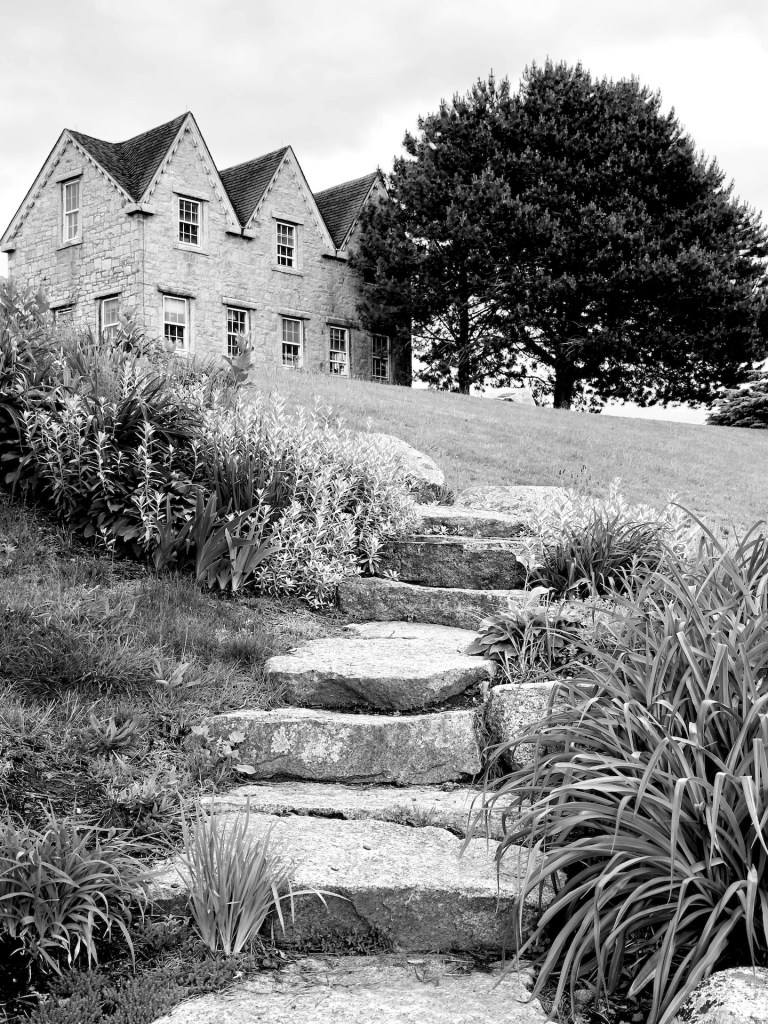
The house Fitz Henry Lane built, from Cape Ann granite, is today owned by the City of Gloucester. Handsome, plain and freshly cleaned, it stands on a hill at the waterfront and commands a fine view of Gloucester Bay. But for a long time after Lane’s death in 1865, the painter was forgotten and his many portraits of ships collected dust in grand houses throughout Boston and Cape Ann. Meanwhile the Lane House sat alone on its hill, neglected. It passed from one owner to the next.
Among these owners was the Polisson Family. Wandering through the Cape Ann Museum, I come across a black and white photo of the Polissons, in front of their new home. A date is scratched into the lower-right corner: April 6, 1914. The date is in Greek.
Five Polisson children sit cross-legged on a kourelou village rug in the foreground. Directly behind are two seated bouzouki players, in suits. Between them is a third man in a suit, possibly the singer. Other family members in white shirts and dresses stand at the back and form a kind of frieze or chorus. On the left is a moustached man with a cigar clamped in his mouth. He holds a tray of glass tumblers filled with wine. A man to his right, in a flat cap and tie, holds a roasted lamb on a long wooden skewer. The Easter feast is about to begin.
A quick picture, then, before we eat. That’s it. Hold it, now.
* * *
Jesus in Prague comes to mind. How the wheel of time turns, how things come round, with the seasons and the generations, but always with small surprises, with fresh signs of death and resurrection, with evidence of the sublime and ridiculous.
 because i said