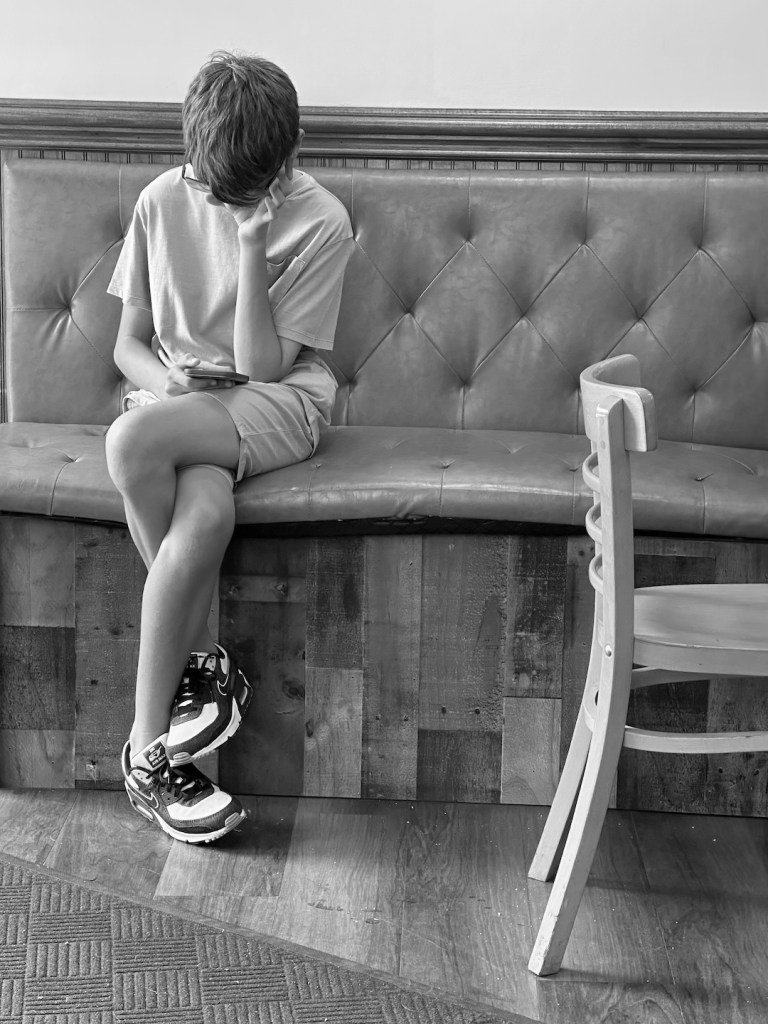
I’m sitting in Cafe Sicilia, in Gloucester, Massachusetts, listening to a couple of beefy men engaged in grave, whispered conversation. They’re tanned and wearing work clothes and speaking in what sounds to me like an Italian dialect. A lady offers them a seat on her bench, since they’re standing. But they politely decline, down their espressos and leave. In a corner of the café, a family of five sit in front of their untouched cannellonis. They stare at their phones.
When you enter Cafe Sicilia, the first thing you see is a five-foot square piece of AstroTurf glued to one wall. The AstroTurf is decorated with red neon letters that say Ciao!
The other thing you’ll notice is a three-foot-high painted statue of the Virgin and Baby Jesus. They stand on a high shelf above the counter: Crowned, solemn, making gestures. To the right and just behind the Virgin’s skirts is St. Joseph. He’s about a third smaller than the wife, but doesn’t seem to mind. Immediately to the left of the Virgin and Child, like a shimmering crowd of worshippers, stand a dozen bottles of bright green dishwashing liquid. These are for sale.

Rough business
On our first visits to Gloucester, some years ago, the waterfront was rougher. People had warned me, made jokes about it. But there’s nothing like the sight of a drunken sailor, normally part of a punchline, to cure you of the notion that there’s anything funny about a drunken sailor. You see less of that now, maybe because of tourism and gentrification.
Tourists and their money are welcome in Gloucester, but the real business is still out there, on the water. It’s a rough business. You can tell as soon as you drive in. The roads are clogged with massive tractor trailers, circling the warehouses or parked with their engines running, waiting to be loaded with fish. There used to be more fish. But in the crowded harbour, big trawlers still tie up at Cape Ice to fill their holds (with blocks, cubes, crushed ice or shaved) before heading out to sea. Meanwhile the surrounding yards — filled with rusting iron hulks and decaying wooden boats — function like ICUS. Large men with tools clamber over the stricken vessels all day, fighting to stem the decay.

Gloucester was first settled by Europeans 400 years ago, making it one of the oldest ports in the United States. In the 19th century, these waters were still seething with so many fish there simply weren’t enough skilled hands to get them onto boats and to market. So the Irish came for the steady work, followed by the Portuguese (mostly Azoreans) and Italians (mostly Sicilian). Canadians arrived, too, by the boatload. By the end of the century about half the workforce was Canadian-born, largely from Nova Scotia and Newfoundland.
These immigrants prospered, bought and manned their own boats, started families, built churches and, for those lucky enough to not die at sea, filled cemeteries.
* * *
During our three days in Gloucester, I’ve lingered at Cafe Sicilia three times. The espresso here isn’t the best in town. And, to tell the truth, the cookies and pastries aren’t all that good either. But why would I take my coffee anywhere else?

 because i said
Beautiful pictures, as always!x M.Envoyé depuis mon appareil Galaxy
LikeLike
Thank you Michelle!
LikeLike
Great ending!
´nough said.
K
•••Karimobile
514 9944433
LikeLike
You are very wise and discerning. I’ll explain when I see you. Kisses!
LikeLike
… and the shot of the kid is nothing less than exquisite xx
•••Karimobile
514 9944433
LikeLike
Gritty, tacky, and espresso good enough for the founding fathers. Why indeed. Thanks for taking me there.
LikeLike
Thanks, Gerry, for coming along. You’re always a good passenger.
LikeLike
I saved this for a quiet moment, glad I did.
<
div>I lingered over the opening photo for almost as long as I spent
LikeLike
Thanks, Alison. Sometimes quiet moments are hard to find, so I’m glad you found one.
LikeLike